Showing posts with label Andrew Sullivan. Show all posts

Tuesday, February 24, 2009

How the Surge Became One of the Biggest Swindles in the History of American Foreign Policy


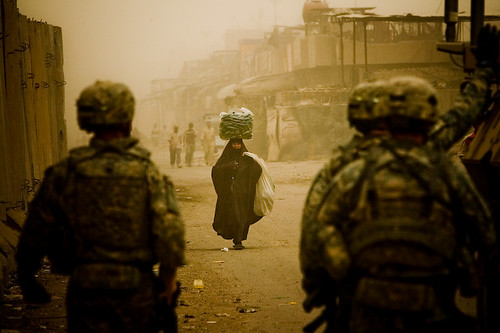
In February 2006 Al Qaeda bombed the al-Askari Mosque in Samarra, Iraq. The attack was Abu Musab al-Zarqawi's crowning achievement, setting off the bloodiest and most grisly phase of the civil war in Iraq. The escalation of the war and the brutal ethnic cleansing campaigns carried out by all sides helped to turn American public opinion decisively against the war and played no small role in the wins of the Democratic party in the November 2006 mid-term elections. While many inside and outside of Washington were finally ready to start looking for an exit, the Bush administration, its legacy already inescapably tied to the war in Iraq, decided to double down. President Bush announced the troop surge on January 10, 2007, and the additional troops began entering Iraq before the end of that month.

Midway through 2007 the levels of violence began to tail off, and by the end of the year attacks and casualties had fallen to their 2004-05 levels. In September 2007 General David Petraeus and Ambassador Ryan Crocker reported to Congress that while virtually none of the political objectives of the surge had been met, the military objectives of the surge were being met. Over the course of 2008, it became conventional wisdom among political talking heads of all stripes that, notwithstanding the failure to achieve the political objectives, the surge had succeeded. John McCain prevailed in the 2008 Republican primaries largely on the basis of having been a champion for the surge. Mainstream newspapers called out Democratic candidate Barack Obama for failing to admit that he had been wrong about the surge. And Obama, for his part, seemed content to support this conventional wisdom on the basis that if the surge had worked, then it must be time to bring the troops home. This conventional wisdom has been augmented by the fact that the decline in casualties and violence has generally taken Iraq off the front pages. For the past year the conflict has been largely out of sight and out of mind, which itself serves as evidence of the apparent success of the surge and also diminishes public discussion that might lead to challenges of the conventional wisdom.

Lately, however, something odd has started to happen. Thoughtful and serious people, with whom I often agree, are employing the apparent success of the surge as justification for a much longer term commitment to keeping troops in Iraq (e.g. Thomas Ricks and Andrew Sullivan). Let me put aside for the moment the fact that I don't believe that the surge was the primary cause for the decrease in violence in Iraq (in fact, it probably wasn't even the secondary cause). Even if we assume that the surge was solely responsible for the decline in violence, the fact that we are today not one iota closer to solving the basic structural political challenges of Iraq than we were three years ago should reveal the surge to all as the utter failure that it is. In truth it stands as a testament to the hollowness and stupidity of the entire endeavor in Iraq from day 1. The question of how to resolve the ethnic/sectarian divisions of Iraq was at the top of every critic's list of objections before the war started in 2003. Here we sit in 2009 and still no one has the first fucking clue how to resolve this problem. And yet Ricks and Sullivan would have us keep tens or hundreds of thousands of troops in Iraq for at least another 5 years in hopes that someone can pull a rabbit out of a hat and make everything better. I hate to be the one to break it to these fellas, it ain't gonna happen.

When I go back and look at what I wrote about Iraq two or three years ago, I see little that has occurred to change my evaluation. It's true that the decline in violence has bought us some time (although the levels of violence have been ticking up again, possibly in reaction to last month's elections). But time for what? There still appears to be little prospect for political reconciliation, meaning that whatever fallout will result from an American withdrawal will happen whether we withdraw this year or in 2015. And our presence in Iraq continues to cost us the lives of our servicemen and an immense amount of money, strain our military capacity and limit our effectiveness in Afghanistan, and hinder our efforts to repair relations with Arab and Muslim nations. The opportunity costs of remaining in Iraq are substantial, and the benefits of staying appear to be minimal. It's time to bring this misadventure to a close.

I remain of the opinion that we should be prepared to intervene again if things spiral too badly out of control, but I do not believe that we will see a serious effort towards political reconciliation until we force the issue by drawing down our forces. We have no better options than to try it and see what happens. The surge has not altered that equation. It has only delayed us, at significant cost, from asking the hard questions and making the hard decisions for the past two years. Now is the time to do what needs to be done.

Photo credit Zoriah

Tuesday, November 25, 2008

Some More Rawls Discussion

Speaking of meritorious blogging content, someone smart must have submitted this email to Andrew Sullivan. :) Having appeared on Fallows' blog some time ago, I wonder if this qualifies me as an Atlantic Monthly groupie.

The Brave New Media World

Henry,

You raise a few interesting points. First, I would just note that your major premise is one that we've discussed a few times at Boys' events, although I can't recall whether you've been present for any of those discussions. It was the subject of a short but prescient book by Cass Sunstein titled Republic.com. He argued, precisely as you have, that proliferation in media sources will fuel self-selection of sources that confirm preexisting biases, undermining our cultural common ground and fragmenting our social beliefs. I think the threat is real, but can be overstated (as I'll discuss further below).

Second, I know exactly what you're talking about with regards to the comment sections on news sites. That stuff is purely toxic. It's even worse than you find on the purely partisan blogs and forums (e.g. DailyKos or RedState). News sites and YouTube comment threads and things of that nature appear to draw the absolute dregs for commenters. It's disturbing to read it, but ultimately I don't think that amounts to much. I suspect that it really is a very small percentage of the people who read the news stories or watch videos who post those comments (and probably with a high percentage of repeat players from one site to another). The numbers of people who participate in sites like DailyKos and RedState are more significant. Of course, those people also tend to suffer from groupthink and hyperbole and certainly represent a fragmentation in worldviews. But again, I'm not yet convinced that this is especially problematic. Their influence is ultimately fairly limited, as each party's Presidential primary this year demonstrated. In both cases the netroots favorites (Edwards for the Democrats, anybody-but-McCain (Ron Paul?) for the Republicans) failed to win.

Ultimately I think the democratization of public discourse via the Internet has been a tremendous win for the public. Contrary to your contention that we've seen a disappearance of sincere public discourse, I think we're seeing the emergence of new and important avenues for public discourse. There is a dialogue taking place on a community of blogs that surpasses in intelligence and candidness anything I can recall from the pre-Internet (or early Internet) days. To name just a few: Andrew Sullivan, Obsidian Wings, Matt Yglesias, Nate Silver, Al Giordano, Dan Drezner, Greg Djerejian, Ezra Klein, Tyler Cowen, John Cole, Cunning Realist, Josh Marshall. This short list covers a pretty broad spectrum of opinions (and certainly there are many others out there). These people are intelligent, generally well-educated, have diverse areas of expertise, and are interested in honest and sincere dialogue. Better yet, many of them read one another (and many other bloggers) and actually engage in back-and-forth discussion.

While the readership of the blogging community is still not at the same level as traditional media consumption, I think its influence is considerable. The bigger blogs (Sullivan, Marshall) draw in the neighborhood of a million page views a day, which is not insignificant. Moreover, that readership is disproportionately drawn from politicians (or at least political staffers), policymakers, and the media. This blogging community has the ability to affect campaign narratives. I think this is one of the reasons the McCain campaign flailed so wildly from one narrative to another over the Summer and Fall. The McCain strategists, all Karl Rove proteges, couldn't understand why their Obama narratives were not sticking the way the Al Gore - fibber and John Kerry - aloof liberal narratives stuck. The bloggers ripped their idiotic narratives to shreds and were quick to pounce if the traditional media went too far astray.

The emergence of this community presents a challenge to Sunstein's predictions. Certainly there is plenty of evidence on the Internet of Sunstinian self-selection and reinforcement of biases. But there is also a conscious acknowledgment among others that in order to be relevant as a thinker and a political writer one must be willing to inhabit the same world as other writers and one must be willing to engage differing views on more than a superficial level. Certainly this creates some tension between the self-reinforcing Freepers and Kossacks and the reality-based bloggers. On the conservative side this tension has spilled over into something like open warfare with the Freepers and Redstaters attempting to expel any conservatives who do not fully acquiesce in the Bush/Rove Republican orthodoxy. It's not clear how this is going to play out, although it seems inevitable that it will end badly for the Freepers, who are at this point quite remote from reality.

To conclude, I think, Henry, that you and Sunstein both had useful insights into the impact of hugely diverse media landscape, but I think the danger here is easily overstated. The broad expansion of the media landscape has occurred because the barriers to publication have dropped to almost nil (case in point: the Boys Weekend Journal), and the elimination of these barriers has also had tremendously positive effects. It does require people to be more savvy in their consumption of, and interaction with, the news, but the Internet has also made a great many people far more savvy about news media than the public has previously been. And the ease of entry into the market and the ease with which consumers can move from one product to another has allowed for something much closer to a true meritocracy than has ever existed in the traditional media. Nate Silver could never have gone from obscure bystander to political media powerhouse in less than a year in the old media market. I would go so far as to say we are entering a renaissance of political discourse. But the interplay between substantial number of people who have defied Sunstein's expectations with the still considerable masses who have conformed to his expectations does warrant continued observation. While relations between the two groups may frequently be strained, I think by virtue of pure merit alone the reality-based bloggers will always remain relevant and important.

Thursday, September 20, 2007

The Role of Work

Andrew Sullivan pointed out this fascinating article on the psychological impacts of employment (and unemployment). I take issue with many of the conclusions the author, Arthur C. Brooks, draws from the data he presents, but the data is worth taking a look at. In particular I'm drawn to the studies on the devastating impact of unemployment, as in the case of the Marienthal villagers or the University of Chicago survey that found that even a brief bout of unemployment drastically increased the tendency of respondents to feel hopeless or worthless.

Brooks concludes his survey of the data by stating that the only thing we need to do is "protect the free market so that people can find and choose the types of employment that suit each of us best." I find this conclusion difficult to reconcile with the data on unemployment. The implications of that data suggest to me that employers have a devastating non-economic advantage to wield over employees, and that normal market churn can have significant psychological externalities that aren't generally considered in economic models.

One need not be a bleeding-heart sympathizer with the poor or the unemployed to be concerned with such issues. Witness the current political dialogue on topics such as economic globalization, outsourcing, and immigration. I would suggest that the rising populist positions on all of these issues share two traits: they are motivated by fear of unemployment and all its consequent harms, and they are deleterious to the overall health of our economy. Note also that these issues tend to span across the usual political divides. You can find vehement opposition to immigration on the right, fierce opponents of globalization on the left, and distaste for outsourcing on every side. People have a tremendous fear of losing their jobs, a fear that viewed in purely economic terms may seem irrational, but taking into account the additional psychological effects perhaps it is not so irrational after all (although I guess you could conclude that the psychological impact is itself irrational).

Brooks points out that remedies such as welfare do little to address the psychological harm of unemployment. He also notes that making jobs more secure comes at a price. Brooks argues that more secure jobs tend to be less meaningful. I don't see the data for that, and I'm not sure it's right although I can see where he's coming from. In any case, certainly there is an economic price to be paid for making it more difficult for employers to adjust their workforce (European economies demonstrate this).

These considerations about welfare and job security seem to drive Brooks's conclusion that nothing should be done other than to support the market. And certainly, the market may provide enough of a remedy for some of the unemployed, particularly the highly skilled and well-educated. However, that does not address the whole of the topic. Particularly where globalization and outsourcing are concerned and where we see massive shifts in the market, people may find that skillsets in which they had invested a great deal of time, effort, and money are no longer needed, not just by their previous employer, but by any domestic employer. There is room here for the government to be involved in retraining and job placement for displaced workers. If we know that job churn is necessary and healthy for the economy, but that the impact on individuals of this churn can be severe, that seems the most sensible route to pursue. Not only can this have direct impacts on the social welfare of those affected, but the existence of such a safety net may also help reduce the fear that drives the dialogue on economic policy in the wrong direction. There is an obvious connection between this suggestion and our past discussions of Rawlsian fairness and political compromise (as seen here), but I'll leave that as an exercise for readers...

Wednesday, September 12, 2007

Islam Isn't the Problem

Well, I haven't been posting as much as I'd like lately. I just haven't crossed that much that sparked my interest lately. But I think this is important (and it ties in to my previous post as well). This global Gallup poll of Muslims is significant, as its title says, in framing the war on terror. Gallup found that Muslims in the Middle East actually have a lower tolerance for attacks on civilian targets than do average (non-Muslim) Americans. The poll found only a weak link between religiosity and political extremism among Muslims. Gallup notes that while those who found the 9/11 attacks to be wrong often seated those beliefs in religious sentiment, those who thought the attacks justified relied on political rather than religious justifications. The summary of poll concludes that "the difference between those who condone terrorist acts and all others is about politics, not piety."

These are important findings, not only in countering the rhetoric of the more jingoistic right wingers, but also in countering certain middle ground positions (i.e. Andrew Sullivan) that reject the more extreme policies that arise from such rhetoric while still embracing the framing of Islam as the root source of our problems. This conflict is and always has been about political differences. The pollsters find that the Muslims who sympathize with extremism tend to be those who believe that the West does not reciprocate their concerns and is unlikely to ever act on them, creating a siege mentality. This is not a new idea, at least on this blog, but solid data is always a welcome addition to the argument. We cannot hope to end this conflict without at the least understanding the motivations of our adversaries.

Saturday, June 16, 2007

Political Liberalism

A week ago a philosopher named Richard Rorty passed away. I had never heard of Rorty, but his passing prompted a round of discussion between New Republic writer Damon Linker and Atlantic bloggers Matt Yglesias, Ross Douthat, and Andrew Sullivan. Certainly any discussion that involves 3 of the Atlantic's 5 bloggers is likely to catch my attention, but particularly one that involves John Rawls's concept of political liberalism as heavily as this one did. Hank and I had some discussion of Rawls here last winter, but we focused on his two principles of justice rather than the general concept of political liberalism. I thought this might be a good chance to discuss it a bit. I find it to be highly relevent in contemporary politics. Whether or not Sullivan would admit to being a Rawlsian (probably not), there is a strong strain of Rawlsian political liberalism in comments like this one:
Count me convinced of the case for forgoing moral certainty in politics in favor of a shallower, skeptical formalism of live-and-let-live.

The genius of America, it seems to me, is its capacity to include people of radically different worldviews within a loose, flexible and constantly adjusting constitutional system. Given the huge differences between, say, a born-again evangelical in Georgia and a pot-smoking post-boomer in Seattle, no single cultural strait-jacket can ever hold America together. That's why we mercifully don't have such a strait-jacket, despite the excesses of the cultural left and right. We have a constitution that allows us to live together and even learn from each other in a morass of competing life-choices.
And when Barack Obama made his highly regarded speech on politics and religion last summer (video: part 1, part 2, part 3, part 4, part 5) he went directly to Rawls's playbook for this:
This brings me to my second point. Democracy demands that the religiously motivated translate their concerns into universal, rather than religion-specific, values. It requires that their proposals be subject to argument, and amenable to reason. I may be opposed to abortion for religious reasons, but if I seek to pass a law banning the practice, I cannot simply point to the teachings of my church or evoke God's will. I have to explain why abortion violates some principle that is accessible to people of all faiths, including those with no faith at all.

Now this is going to be difficult for some who believe in the inerrancy of the Bible, as many evangelicals do. But in a pluralistic democracy, we have no choice. Politics depends on our ability to persuade each other of common aims based on a common reality. It involves the compromise, the art of what's possible. At some fundamental level, religion does not allow for compromise. It's the art of the impossible. If God has spoken, then followers are expected to live up to God's edicts, regardless of the consequences. To base one's life on such uncompromising commitments may be sublime, but to base our policy making on such commitments would be a dangerous thing.

Rawls first gained notoriety from his book A Theory of Justice. In it Rawls attempted to develop a comprehensive political philosophy. He developed from first principles a full system of political justice and fairness resulting in a well-ordered society. But this required Rawls to make many philosophical commitments along the way. In defending A Theory of Justice from its critics (and there were many) over the next decade or so Rawls came to the conclusion that it was unrealistic to believe that any such comprehensive theory would capture the public imagination such that everyone would adopt it. This was particularly so when he considered that his theory was in competition with other comprehensive theories, namely religions, to which people tend to be quite attached. People had too many existing philosophical commitments.

So Rawls decided that a comprehensive approach to political philosophy wasn't particularly fruitful. What was needed was a way to reconcile the many existing and competing comprehensive theories already present in our society into a workable political theory. This motivated his second major book: Political Liberalism. The goal was no longer to try to establish his theory of justice as being true, but rather to make it a focal point of social agreement among a pluralistic mish-mash of comprehensive philosophies.

Rawls presents a long and fairly complicated theory in Political Liberalism and I won't attempt to sum it all up here. But there are two points I'd like to pull out:

First, Rawls sets a baseline for the participation of any comprehensive philosophy in a pluralistic democracy. Rawls requires that all must be reasonable. He defines reasonable to mean that they a) be willing to abide by rules of fair cooperation as long as others do the same, and b) that they accept Rawls's concept of "the burdens of judgment". The burdens of judgment reflect the fact that on deep philosophical questions (the focus of comprehensive doctrines) our evidence is complex and conflicting, weighting is difficult, many concepts are vague, there is much reliance on life experience and competing normative considerations. So we should expect different conclusions about what makes life good even from perfectly rational and reasonable people. Any comprehensive philosophy that cannot accept this uncertainty, that insists that only its conclusions can be true, is one that cannot peacefully exist in a pluralistic democracy. This is what Sullivan is talking about in the excerpt above (and in much of his book from what I gather). It's a simple concept, but one that went out of fashion with the rise of the religious political right, and is only now making a comeback.

The next point relates to part (a) above. As one of the rules of fair cooperation that Rawls suggests any comprehensive philosophy compatible with pluralistic democracy needs to accept, Rawls proposes public reason. Public reason is a way of talking about political issues in a language that everyone can understand. Obama's excerpt above pulls directly from Rawls's thoughts on public reason. Political actions must be taken for reasons that everyone (regardless of respective comprehensive beliefs) can see as legitimate, even if not everyone agrees on them. Actions motivated purely by artifacts of one comprehensive doctrine will not be seen as legitimate by supporters of other comprehensive doctrines. So, as Obama says, if you want to take such ideas into the public sphere they need to be reseated in principles more broadly accessible to everyone; simply citing chapter and verse of the Bible isn't good enough. Rawls argues that any argument that assumes that the listener shares the same comprehensive doctrine as the speaker (or should convert to the same doctrine) fails to respect the burdens of judgment and is an argument inappropriate for public politics in a pluralistic democracy.

Next time I hope to discuss the bloggers' discussion of Rawls and Rorty...

Sunday, May 27, 2007

Why The Atlantic Kicks Ass

The Senate Select Committee on Intelligence made big news this week by publicizing prewar analysis from US intelligence agencies predicting the difficulties that we would have in Iraq. These reports were buried by the administration in their push for war. For many this was just one more stunning revelation of the recklessness and dishonesty of the Bush administration. For readers of The Atlantic Monthly, however, it was old news. James Fallows reported on this in January of 2004, and I blogged it here in July of that year. Nice to see that the Senate is catching up. I shouldn't be snarky; this is a good thing. Now that Democrats control the agenda in the Senate they can finally drag some of these things out into the light of day, and they should. But in any case, I think kudos are in order to Fallows and The Atlantic.

Update: Apparently Andrew Sullivan is not an Atlantic reader. He was shocked and outraged by this new report. Excerpt:
Just to anger up the blood some more, it's now clear, thanks to the latest Congressional report, that this president was warned starkly about the dangers of "a surge of political Islam and increased funding for terrorist groups" as a result of an invasion of Iraq. He was told that Iraq was "largely bereft of the social underpinnings" for democracy. He was explicitly informed that there was "a significant chance that domestic groups would engage in violent conflict with each other unless an occupying force prevented them from doing so." And yet he still sent a pathetically insufficient occupation force in 2003 - and refused to increase it for three years of growing chaos and mayhem. Even if you excuse the original recklessness, the persistence in it - until our current point of no return - is and was criminal negligence - a callous disregard for your security and mine.

The gravity of the mistake this country made in 2004 by re-electing al Qaeda's best bet is only now sinking in as deep as it should. I fear, however, that we have yet to experience the full and terrifying consequences of that historic mistake.

Wednesday, May 23, 2007

Al Gore and TV Culture

I was deeply impressed with this excerpt from Al Gore's new book The Assault On Reason from Time Magazine. It's heavily Amusing Ourselves to Death influenced. It makes a half-hearted diversion into being an advocacy paper for net neutrality in the closing paragraphs, but that may just be an artifact of reformatting the book into excerpt form, because prior to that turn the excerpt appeared to have a rather grander design. I'll be curious to see reviews of the whole book. I think Gore diagnosed the problem pretty well here, and I surely hope net neutrality is not the entirety of his answer. I have to concur with Andrew Sullivan, I much prefer the new public intellectual version of Al Gore to the old political candidate version. I hope he doesn't let himself be dragged into the 2008 race.

Wednesday, April 25, 2007

I've Waited Six Years for this Foreign Policy Address

Barack Obama's foreign policy speech. He gets it all right. Not just on policy, but on tone and approach, which in foreign policy are at least as important as the X's and O's. This is where we should have been on September 12, 2001. A lot of people (primarily political junkies) already resent the Obama hype level (see Slate's Obama Messiah Watch), but the guy keeps hitting them out of the park. Andrew Sullivan's comments:
Obama's speech yesterday is his most detailed yet on foreign affairs. It is emphatically not isolationist; it is emphatically not against the use of military force when necessary; it is emphatically pro-military in its call for many more troops. On the critical issue of Iraq, Obama has taken a stand - a clear one for withdrawal, with the possibility of a strike-force over the horizon. This is a very difficult call, and the timing and execution of withdrawal will be dispositive. But one core strength of Obama's candidacy is that he got this war right when many of us got it wrong. He deserves more of a listening than many of us do. If his speech yesterday was any indication, there will be much to chew on. I'm sorry to see no commitment to a carbon tax; I'm unsure of whether diplomacy can or will work with Pyongyang and Tehran. We will all have to listen and watch Obama closely these next few months in weighing his candidacy against others'.

But this much we can already say: Obama brings something no one else does to this moment. By replacing one of the most globally despised and domestically divisive presidents in American history with a young leader half-Kansan and half-Kenyan, America would be saying something to the world: Bush-Cheney is not who we are. America is not what it has come to appear to be. This country is among the most culturally and racially and religiously diverse on the planet. America has long been a powerful and vital beacon for human rights - not, as recently, the avatar of torture, rendition and executive tyranny. The simple existence of Obama as a new president in a new century would in itself enhance America's soft power immeasurably, just as a clear decision to leave Iraq would provide much greater leverage for diplomacy and military force in a whole variety of new ways. Obama would mean the rebranding of America, after a disastrous eight years. His international heritage, his racial journey, his middle name: these are assets for this country, not liabilities.

This is the reason for his ascendancy. This is what the American people sense and the world awaits. This is what the Islamists fear. That last alone is reason to feel hope.

And the reaction over at DailyKos? Obama presents a "weak, mealy, and shockingly conservative platform. ... apparently Obama has joined the exalted ranks of the criminally misguided on foreign policy." This, of course, on one of the back pages, because the Kos front page has decided Obama doesn't exist unless they have something they can rag on him for (particularly if they can contrast him with their golden boy, John Edwards).

Sullivan likes it, the Kossacks hate it; I'm sold. I've commented before on the lack of a moderate liberal net presence as sites like DailyKos have drifted farther towards the fringe. So far I haven't found a liberal answer to thoughtful moderate conservatives like Sullivan, The Cunning Realist, Greg Djerejian, and Dan Drezner. I won't be surprised if we start to see some schisms in the liberal netroots over the next 6-8 months as the primary season heats up, and I'm hopeful something a little more reasonable will come out of it.

To close, an excerpt from Obama's address:
In today’s globalized world, the security of the American people is inextricably linked to the security of all people. When narco-trafficking and corruption threaten democracy in Latin America, it’s America’s problem too. When poor villagers in Indonesia have no choice but to send chickens to market infected with avian flu, it cannot be seen as a distant concern. When religious schools in Pakistan teach hatred to young children, our children are threatened as well.

Whether it’s global terrorism or pandemic disease, dramatic climate change or the proliferation of weapons of mass annihilation, the threats we face at the dawn of the 21st century can no longer be contained by borders and boundaries.

The horrific attacks on that clear September day awakened us to this new reality. And after 9/11, millions around the world were ready to stand with us. They were willing to rally to our cause because it was their cause too – because they knew that if America led the world toward a new era of global cooperation, it would advance the security of people in our nation and all nations.

We now know how badly this Administration squandered that opportunity. In 2002, I stated my opposition to the war in Iraq, not only because it was an unnecessary diversion from the struggle against the terrorists who attacked us on September 11th, but also because it was based on a fundamental misunderstanding of the threats that 9/11 brought to light. I believed then, and believe now, that it was based on old ideologies and outdated strategies – a determination to fight a 21st century struggle with a 20th century mindset.

There is no doubt that the mistakes of the past six years have made our current task more difficult. World opinion has turned against us. And after all the lives lost and the billions of dollars spent, many Americans may find it tempting to turn inward, and cede our claim of leadership in world affairs.

I insist, however, that such an abandonment of our leadership is a mistake we must not make. America cannot meet the threats of this century alone, but the world cannot meet them without America. We must neither retreat from the world nor try to bully it into submission – we must lead the world, by deed and example.

Tuesday, March 20, 2007

Obama's Track Record

Thanks to Andrew Sullivan for digging up this slightly dated (October of last year) account of how Barack Obama kept himself busy during his two years in the Senate. Keep it in mind while you're being battered by the talking point about Obama having not done anything. The basic summary:
...I do follow legislation, at least on some issues, and I have been surprised by how often Senator Obama turns up, sponsoring or co-sponsoring really good legislation on some topic that isn't wildly sexy, but does matter. His bills tend to have the following features: they are good and thoughtful bills that try to solve real problems; they are in general not terribly flashy; and they tend to focus on achieving solutions acceptable to all concerned, not by compromising on principle, but by genuinely trying to craft a solution that everyone can get behind.
Also, a follow-up on prosecutorgate, Lincoln Caplan has an informative column on Slate on the proper role for politics in the justice system. He handily rebuts the oft-repeated canard about Clinton replacing the US attorneys when he took over by noting that in the past 25 years the number of US attorneys forced out mid-term for reasons other than misconduct is somewhere between two and five.

Saturday, February 10, 2007

A Dialogue On Faith

I've been meaning to point out a wonderful dialogue taking place on faith and atheism between Sam Harris and Andrew Sullivan. It started several weeks ago and is still ongoing. Harris has, I think, done a bang-up job. It's an enjoyable read.

Sunday, January 28, 2007

Kerry and Khatami at Davos

Andrew Sullivan linked approvingly to this blog post ripping into John Kerry for making comments critical of the Bush administration at the World Economic Forum in Davos, in the presence of (gasp!) Mohammad Khatami, former president of Iran. That disturbed me, so I sent him this email:

Mr. Sullivan,

I would be interested to read an explanation for your approving link to Hot Air's blog post ripping John Kerry for his comments at Davos. His comments seemed fairly reasonable; we have consistently burned our diplomatic bridges whether the topic was Iraq, global warming, the International Criminal Court, land mines, nuclear weapons, capital punishment, or torture. And we are facing a crisis of confidence and international isolation. We have been, as Kerry said, diplomatically tone deaf, and it has hurt us badly. I think Kerry is hardly wrong in voicing these concerns. For the most part, they don't seem terribly contrary to comments you yourself have made.

Is the crime merely that he voiced these opinions in the presence of Mohammad Khatami (or "the pig" as Hot Air refers to him)? Should our policy discussion be stifled whenever a Muslim might be listening? Should we imagine that none can see our network news, or read our newspapers or (heaven forbid) your blog? Hot Air suggests that "Khatami's masters" will thrill at these comments critical of the Bush administration. I thought you had disowned the idea that dissent gives aid and comfort to our foes. Isn't frank and open discussion part and parcel of deliberative democracy, even when others are listening? It's not as if they didn't hear all of this from Kerry in 2004 (and having heard it, Iran famously endorsed George W. Bush in the general election -- so much for being thrilled by Kerry's rhetoric).

Furthermore, I'm not certain that vilification of Khatami is terribly useful. Many responsible statesmen have suggested that engaging Iran in a regional dialogue would be to our benefit. Who do we think that dialogue will be with? We may not agree with Khatami across a broad array of issues (and certainly I agree his policies on homosexuality were abhorrent), but is Ahmadinejad better? Is Khamenei? Within the spectrum of politics in Iran, we might not do much better than Khatami. He at least pushed in directions we favored on democracy, on foreign relations, on the rule of law. If we wait to find someone who agrees with us on everything before even engaging in dialogue, then we'll wait (as the Bush administration has) for something that will never happen. Iran is not Iowa, and it is not going to become Iowa simply because we refuse to talk to them. If politics is, as Otto Van Bismarck stated, the art of the possible, we should realize that moderates like Khatami and Hashemi Rafsanjani are our most likely allies in Iran. That doesn't mean we have to agree with them or even treat them as friends, but gratuitous demonization is not going to further our dialogue.

Tuesday, August 01, 2006

Corruption Watch: University Funding

Just a few quick hits today:

CSM has a strong article on the politicization of federal educational and research funding. It's just one more arena for compromised politicians to extend their tentacles into. Remember when Newt Gingrich built a Republican majority around the idea of clean government?

On to Lebanon. It seems that a small coalition of moderate-conservative realists is coalescing around the Andrew Sullivan blog. These include the Cunning Realist, Dan Drezner, and the Belgravia Dispatch. That last, the Belgravia Dispatch, is the source of the single best piece I've seen on Lebanon so far. Key point:

...this was more by way of an ill-advised temper tantrum than a serious military operation, as Arik Sharon would himself admit, if only he were aware of the disaster underway. Sharon would have recalled previous Lebanese quagmires and would have well understood (aided by the wisdom of years and the lack of any need to prove himself) that resort to airpower, in the main, cannot succeed in this context, with the specter of hundreds and hundreds of civilian deaths earning Israel international opprobrium in every world capital (save Washington), and that there is no real, sustained post-'82 appetite in Israel for a massive land incursion regardless, not least given the ultimate futility of same. No, Sharon would likely have chastised Ehud Olmert for his impestuous over-reaction, one so helpfully fanned on by myopic strategic blunderers and amateurs in Washington, both in policy and journalistic circles.

Also, here's a link to Ron Suskind's latest Miller Center appearance. He was there in late June speaking about the One Percent Doctrine. As always he was animated, entertaining, and insightful. He at moments comes off a little bit arrogant, a little pushy, and has the feel of a televangelist. But in general there probably isn't a more captivating speaker on politics and the Bush administration. I've gone back to the video of his last Miller Center speech several times, and I'm sure I'll come back to this one too.

And finally, this is a bit odd for TBWJ, but I thought I'd post a link to this TV ad. Yes it's for Dow Chemical, yes Dow is probably still evil. But it's some of the prettiest photography I've seen in any sort of video, much less a commercial. It plays sometimes before the PBS Newshour, and I can't recall the last time I was so riveted by a TV ad.

Monday, May 08, 2006

Politics and Religion

Andrew Sullivan at his best. I've become a big fan of Sullivan's blog. I disagree with him frequently, but always find his take interesting. He is also a prolific blogger, which makes his blog a good place to see what the latest buzz is.

Friday, March 19, 2004

Foiled By the Internet

There has been a rush of politicians and pundits trying put their own stamp on the recent Spanish elections. Most of them find themselves unable to resist one last opportunity to use their tired (and ridiculous) analogy of Saddam Hussein as Hitler and "old Europe" (and now Spain) as Neville Chamberlain. But like most conservative sloganeering, these claims were catchy and spread quickly. However, in my online discussions, while I found these "appeasment" claims widespread initially, they rapidly collapsed under the unstoppable destructive power of actual Spanish people, who, it seems, also use the internet. Imagine, manufactured spin having, for once, to compete with actual reality. It was really quite enjoyable to see. So I thought, for fun, I would have a side-by-side comparison of some of the things said by American politicians and pundits versus comments made by a number of actual Spanish people on a couple of forums I visit.

"There is no neutral ground -- no neutral ground -- in the fight between civilization and terror, because there is no neutral ground between good and evil, freedom and slavery, and life and death.

"No concession will appease their hatred. No accommodation will satisfy their endless demands."

--Pres. George W. Bush

"Thanks, but the fact that we had a tragedy hasn't clouded my judgement, thanks anyway. What I think about Aznar I've been thinking it for the last 6 years. This has done nothing but re-afirm me in my beliefs."
--Actual Spanish Person


"[Spaniards] chose to change their government and to, in a sense, appease terrorists."
--Rep. Dennis Haster, Speaker of the House of Representatives

"The votes against them were mainly because they lied about who made the bombings, it appears that they knew a few hours after the bombings that it hadn't been done by ETA and they hide that fact for political reasons only."
--Actual Spanish Person


"As you look back through history, and you look at situations that required people to stand up for principle, to stand up and lead and be counted against various threats, appeasement just hasn't worked.."
--Gen. Richard Myers

"The Elections' results would vary a lot depending on the terrorists involved. Many people in Spain was against going to war with Iraq; joining the alliance with USA and UK was a government's decission, it wasn't shared by most of the democratic parties. On the other hand, if ETA is behind this, spanish would vote Aznar's succesor."
--Actual Spanish Person (before the election)


"People are not always strong. Sometimes they indulge false hopes that by lying low, truckling, appeasing, they can avoid danger and strife ... And this is what seems to have happened in Spain."
--David Frum

"We have been fighting against terrorism for more than 20 years, inside the national and international laws. US for 2 years. We have lost more than 250 in "your" war against islamic terrorism. The american citizens lost against against ETA is zero. We have jailed a lot of islamic terrorist, while none of the groups that support ETA in some states like Iowa is in jail... . Maybe you have to read more about history to understand it. For other side, the french has helped us invaluable last 10 years against ETA"
--Actual Spanish Person


"I call on Prime Minister Zapatero to reconsider his decision and to send a message that terrorists cannot win by their acts of terror,"
--Sen. John Kerry

"If we started to talk about USA not helping us, [it] is because some guys started to call us cowards because we retire from IRAK, but all you must have in mind that 80% of Spanish ppl didn't want the war as we don't see the ties betwen IRAK and muslims terrorist and we saw that war more like an economy fact and the attempt to control the petrol production. Also all the lies about massive attack weapons don't help a lot to believe on Bush, Blair or Aznar (and i have [voted for] Aznar twice, but not last time)."
--Actual Spanish Person


"This is beyond appeasement. This is decadence: Terror rages and we tend our garden."
--Charles Krauthammer

"I understand the upset in some of you, fellows, but the main reasons of these elections are internals, and not by the fear of the bombs (we were receiving attacks of the terrorist long before you thought it was a problem)."
--Actual Spanish Person


"In other words, will Madrid be remembered as Pearl Harbor or as Munich? For now the response of too many Spanish voters looks more like Munich."
--Sen. Joe Lieberman

"We have been fighting against terrorism since 1978. We have used the force, we have negociated. We tried to solve the problem without surrending, even when the rest of the world called them 'freedom fighters'. The US has only help us when they saw the problem at home."
--Actual Spanish Person


"The voices of appeasement are being heard in Europe."
--Rep. Henry Hyde

"The main reason. The [disinformation]. In Spain the public tv channels (and radio) are very important, and their actuation has been horrible. The popular members forced all the situation (media, institutional speeches, embassadors) to blame ETA, even the proofs that point AlQuaida. When the people knows it (internet and cellulars), there was a lot of Anger. We felt like the government was cheating us. And doing this the day before the elections is not a very smart move, when more than 25% of people haven't decide to vote until these day. Personally. I had decided to vote PP, but the way they tried to cheat me, I voted in blank. I change my vote not the thursday, but the sunday morning."
--Actual Spanish Person


"Nonetheless, it was still the cowardly alternative. And today Spain has chosen it -- having suffered not Europe's 20 million dead of World War I but 200 dead in the Madrid bombings."
--Charles Krauthammer

"Trust me, guys, it's not Al Qaeda who's made the Socialist Party win the elections, but Aznar's own arrogance, stupidity and Franco-like usage of public television."
--Actual Spanish Person


"the trend in Europe is now either appeasement of terror or active alliance with it."
--Andrew Sullivan

"As far as I am concerned...of course I'd like to see legal actions being taken against [Al-Qaeda]. But I don't think that us being [in Iraq] does any damage to [Al-Qaeda], and for once -which hasn't happened for the last 8 years- I'd like to see the government do what the entire population demanded from them, same population that put them up there."
--Actual Spanish Person

And the final word:

Today, in a local newspaper, there was an article where the author said: "To those that are coming: Remember, without our votes, you?re nobody".

This is what Aznar and his party forgot. This is why they lost the elections.

--Actual Spanish Person

Friday, February 20, 2004

Re: Here Comes Nader

I won't belabor this point, but the Nader thing has always been on the table. It was discussed as far back as last fall that Dean was keeping Nader out of the race and his supporters in the Democratic party. And he did it without having any ruinously radical policy positions. As Andrew Sullivan wrote a few weeks back: "In 2000 Al Gore lost in part because of the far-left Ralph Nader challenge. Dean has managed to bring these voters back into the fold — without making any drastic policy commitments that could come back to haunt him. Kerry in comparison? Gore redux." This was always on the table and was part of the choice voters made when they picked Kerry. Dean represented a compromise: the moderate, centrist policies of a mainline Dem, with the character and grassroots populist credentials to satisfy the Naderites. The mainline Dems rejected the compromise, and now lay in the bed they made themselves.

In any case I still have the feeling that current events regarding Iraq and the economy over the course of the summer and fall will likely trump all of this maneuvering, the results of the primary and Nader's presence. If things are rosy, Bush wins, if they're ugly he loses. Oh, and of course there is always the Osama trump card..