Showing posts with label Iraq. Show all posts

Tuesday, February 24, 2009

How the Surge Became One of the Biggest Swindles in the History of American Foreign Policy


In February 2006 Al Qaeda bombed the al-Askari Mosque in Samarra, Iraq. The attack was Abu Musab al-Zarqawi's crowning achievement, setting off the bloodiest and most grisly phase of the civil war in Iraq. The escalation of the war and the brutal ethnic cleansing campaigns carried out by all sides helped to turn American public opinion decisively against the war and played no small role in the wins of the Democratic party in the November 2006 mid-term elections. While many inside and outside of Washington were finally ready to start looking for an exit, the Bush administration, its legacy already inescapably tied to the war in Iraq, decided to double down. President Bush announced the troop surge on January 10, 2007, and the additional troops began entering Iraq before the end of that month.

Midway through 2007 the levels of violence began to tail off, and by the end of the year attacks and casualties had fallen to their 2004-05 levels. In September 2007 General David Petraeus and Ambassador Ryan Crocker reported to Congress that while virtually none of the political objectives of the surge had been met, the military objectives of the surge were being met. Over the course of 2008, it became conventional wisdom among political talking heads of all stripes that, notwithstanding the failure to achieve the political objectives, the surge had succeeded. John McCain prevailed in the 2008 Republican primaries largely on the basis of having been a champion for the surge. Mainstream newspapers called out Democratic candidate Barack Obama for failing to admit that he had been wrong about the surge. And Obama, for his part, seemed content to support this conventional wisdom on the basis that if the surge had worked, then it must be time to bring the troops home. This conventional wisdom has been augmented by the fact that the decline in casualties and violence has generally taken Iraq off the front pages. For the past year the conflict has been largely out of sight and out of mind, which itself serves as evidence of the apparent success of the surge and also diminishes public discussion that might lead to challenges of the conventional wisdom.

Lately, however, something odd has started to happen. Thoughtful and serious people, with whom I often agree, are employing the apparent success of the surge as justification for a much longer term commitment to keeping troops in Iraq (e.g. Thomas Ricks and Andrew Sullivan). Let me put aside for the moment the fact that I don't believe that the surge was the primary cause for the decrease in violence in Iraq (in fact, it probably wasn't even the secondary cause). Even if we assume that the surge was solely responsible for the decline in violence, the fact that we are today not one iota closer to solving the basic structural political challenges of Iraq than we were three years ago should reveal the surge to all as the utter failure that it is. In truth it stands as a testament to the hollowness and stupidity of the entire endeavor in Iraq from day 1. The question of how to resolve the ethnic/sectarian divisions of Iraq was at the top of every critic's list of objections before the war started in 2003. Here we sit in 2009 and still no one has the first fucking clue how to resolve this problem. And yet Ricks and Sullivan would have us keep tens or hundreds of thousands of troops in Iraq for at least another 5 years in hopes that someone can pull a rabbit out of a hat and make everything better. I hate to be the one to break it to these fellas, it ain't gonna happen.

When I go back and look at what I wrote about Iraq two or three years ago, I see little that has occurred to change my evaluation. It's true that the decline in violence has bought us some time (although the levels of violence have been ticking up again, possibly in reaction to last month's elections). But time for what? There still appears to be little prospect for political reconciliation, meaning that whatever fallout will result from an American withdrawal will happen whether we withdraw this year or in 2015. And our presence in Iraq continues to cost us the lives of our servicemen and an immense amount of money, strain our military capacity and limit our effectiveness in Afghanistan, and hinder our efforts to repair relations with Arab and Muslim nations. The opportunity costs of remaining in Iraq are substantial, and the benefits of staying appear to be minimal. It's time to bring this misadventure to a close.

I remain of the opinion that we should be prepared to intervene again if things spiral too badly out of control, but I do not believe that we will see a serious effort towards political reconciliation until we force the issue by drawing down our forces. We have no better options than to try it and see what happens. The surge has not altered that equation. It has only delayed us, at significant cost, from asking the hard questions and making the hard decisions for the past two years. Now is the time to do what needs to be done.

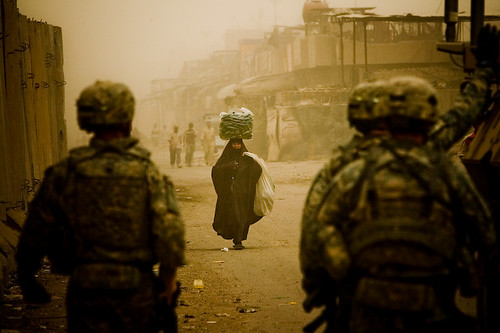
Photo credit Zoriah

Monday, July 28, 2008

A Gaffe That Draws Blood

I have to concede, I am really quite pleased that John McCain started running his mouth about the Anbar Awakening. Before he did, the Conventional Wisdom on the Surge was so firmly established as to appear immovable. Everybody knows, the Surge worked. The fact that there is very little evidence to support that assertion really never came up. And if anyone tried to bring it up, they were scoffed at (as Obama was in the USA Today editorial above). Now that McCain has brought to the fore the fact that the Anbar Awakening, one of the most critical elements of our recent success in Iraq, was unrelated to the Surge, we can start to revisit the Conventional Wisdom.

What I think we'll find is that the real root cause for the turnaround in violence in Iraq had less to do with the additional 20,000 troops than with a change in tactics of which the Anbar Awakening was one element. The dramatic rise of David Petraeus marked the military's final grudging acceptance of the need to engage in actual counterinsurgency operations. After several disastrous years fighting the insurgency, it dawned on the Pentagon that their only real successes came where officers like Petraeus and H.R. McMaster eschewed the major operations that were up to that point the mainstay of the Iraq occupation and adopted classic counterinsurgency tactics. Hell, Petraeus wrote the book on the topic. Petraeus's ascension and this shift in tactics is what made the Anbar Awakening and the later success of the Surge possible.

This is a fairly important distinction, for a couple of reasons. First, is its obvious political impact. McCain has staked much on the fact that he supported the Surge when few others did, and the apparent success of the Surge is supposed to justify any number of prior errors of judgment with respect to Iraq (note how the USA Today article asks Obama to admit he was wrong about the surge, but it doesn't ask McCain to admit he was wrong about invading). If the Surge was not the answer, what does McCain have left to hang his hat on? Even if McCain did back counterinsurgency tactics, and it's not clear he did, that wouldn't be a terribly unique position. This humble blogger criticized the major ops approach to fighting the insurgency as far back as 2003, called for the implementation of counterinsurgency tactics in early 2004, and praised the military's movement in that direction in late 2005. Where was McCain all that time? I could have used his help back then.

Aside from the 2008 election, this debate has other long-term implications. Crediting the Surge for all that has gone right serves the right-wing's ever-popular Green Lantern Theory of Foreign Policy. According to the Green Lantern Theory ("GLT") any military failure is caused by a lack of willpower, and any military objective is achievable given a sufficient reserve of willpower. A corollary to the GLT is that any domestic criticism of either the decision to engage in a military conflict or the conduct of such conflict is a direct attack on the one resource necessary to win such a conflict (willpower) and thereby equivalent to treason. Proponents of the GLT have long scorned concepts such as nationbuilding, the exercise military restraint, respect for local culture, winning of hearts and minds, and, indeed, just about every other element of a traditional counterinsurgency operation. Not only are such things considered to be pointless, but they might weaken our resolve and are therefore deemed harmful to the cause.

Pinning all success in Iraq to the Surge is a perfect narrative fit for the GLT. Just when everyone else wanted to discuss withdrawal, George W. Bush rode the rescue with bulging reserves of willpower and not only refused to withdraw, he upped the ante as a tangible demonstration of his generous endowment of resolve. And lo, victory was achieved. If this is the narrative that comes out of the Iraq war, we will all live to regret it. The United States and Iraq alike paid a painful and bloody price to learn the lessons that the GLT proponents hope to obscure in a haze of Surge-o-philia.

In truth what we learned this time around are a lot of the lessons we should have learned from Vietnam. Indeed, Robert McNamara basically did learn those lessons. It is no coincidence that so did David Petraeus and H.R. McMaster. Petraeus wrote a doctoral thesis at Princeton titled "The American Military and the Lessons of Vietnam." McMaster also wrote a doctoral thesis on the mistakes of the American military in Vietnam. The lessons were there to be learned, but few among conservative policymakers and the Pentagon brass did, enamored of the GLT as they are. Will we walk away from Iraq with the public and policymakers learning all the same wrong lessons so that the next time around we will, at terrible cost, have to rediscover the right ones all over again? I surely hope not. And I hope that McCain's gaffe will open the door to a more robust public dialogue on this topic.

Sunday, May 27, 2007

Why The Atlantic Kicks Ass

The Senate Select Committee on Intelligence made big news this week by publicizing prewar analysis from US intelligence agencies predicting the difficulties that we would have in Iraq. These reports were buried by the administration in their push for war. For many this was just one more stunning revelation of the recklessness and dishonesty of the Bush administration. For readers of The Atlantic Monthly, however, it was old news. James Fallows reported on this in January of 2004, and I blogged it here in July of that year. Nice to see that the Senate is catching up. I shouldn't be snarky; this is a good thing. Now that Democrats control the agenda in the Senate they can finally drag some of these things out into the light of day, and they should. But in any case, I think kudos are in order to Fallows and The Atlantic.

Update: Apparently Andrew Sullivan is not an Atlantic reader. He was shocked and outraged by this new report. Excerpt:
Just to anger up the blood some more, it's now clear, thanks to the latest Congressional report, that this president was warned starkly about the dangers of "a surge of political Islam and increased funding for terrorist groups" as a result of an invasion of Iraq. He was told that Iraq was "largely bereft of the social underpinnings" for democracy. He was explicitly informed that there was "a significant chance that domestic groups would engage in violent conflict with each other unless an occupying force prevented them from doing so." And yet he still sent a pathetically insufficient occupation force in 2003 - and refused to increase it for three years of growing chaos and mayhem. Even if you excuse the original recklessness, the persistence in it - until our current point of no return - is and was criminal negligence - a callous disregard for your security and mine.

The gravity of the mistake this country made in 2004 by re-electing al Qaeda's best bet is only now sinking in as deep as it should. I fear, however, that we have yet to experience the full and terrifying consequences of that historic mistake.

We All Want Out of Iraq...

...but we can't shirk our responsibilities.

I'm going to stick with Matthew Yglesias (who I've been reading quite a bit of since The Atlantic picked him up as one of their regular bloggers), although many people have expressed similar sentiments about the Iraq funding bill, particularly at the major liberal blog sites. Yglesias was disappointed that Democrats didn't fight on the funding bill to the bitter end. I dissent. I was hugely critical of the Democratic votes in favor of the original Iraq war authorization bill, and my bitterness on that front has not receded a bit these past five years. But I think that Democrats in Congress did what needed to be done with this funding bill. They fought a good fight in the public eye, passing a bill with benchmarks and defending it in the media although it was doomed to be vetoed from the start. They forced Republican congressmen to stand up and publicly support the president's policy in Iraq (a stand many of them will regret next year). They pushed the president to negotiate with them, and were rebuffed. He was not going to negotiate. And if we have learned anything about George Bush, we should know that he would not have backed down, regardless of what the Democrats did. They simply didn't have the votes to overcome a veto, and everyone knew it. That left them with but two options: capitulate or defund the Iraq war.

I want out of Iraq as much as anyone, but I would not have us abandon our responsibilities there. A precipitous and complete withdrawal is just not an option. Extricating ourselves from this mess will be a delicate operation. I believe we need to get our troops out soon, because as far as I can tell all they are accomplishing is to maintain a miserable status quo. Our presence is inhibiting any progress by the Iraqis and preventing the situation from evolving. But I have no confidence with respect to what happens when we leave. Things could move in any direction from there. Some of what might happen (and here I have visions of Rwanda) would be utterly intolerable. If we see things proceeding in that direction I feel that we will be obligated to bring the troops back in to put a lid on things and try again. Even if it costs us, even if we don't have a clear path to success. We have a responsibility, an obligation to the Iraqi people that I hope we do not forsake. We will need to be careful with our withdrawal and keep sufficient force in the region to react to events as needed. We will need to maneuver deftly to retain enough influence in Iraq to nudge things in the right direction without appearing to interfere. Defunding the Iraq war will not accomplish that. What we need is open heart surgery, and the only tool the Democratic Congress had was a sledgehammer.

This means, of course, that we will have to continue to live with Bush's management of the war for the time being. So be it. Elections have consequences, and the American people voted for the war in the 2002 midterm election and ratified that decision when they reelected George Bush in 2004. Last year's midterm doesn't erase all that. Now we're stuck with the president we have. Maybe over the next year enough Republican congressmen will defect to allow Congress to force a responsible withdrawal on Bush. If so, great. If not, then we just have to live with him until we can get a president who can deal with this conflict like an adult. The hardline "bring the troops home now" positions I see on so many liberal blogs these days are no more responsible than the policies Bush is pursuing in Iraq today. It's no cause for celebration, but Democrats in Congress did what needed to be done, and I respect them for it.

Saturday, May 26, 2007

The Alternate Reality of the Right

In considering the "fighting them there so they won't come here" argument, Matthew Yglesias points out the obvious conflict between symbolism (retreating from Iraq makes us look weak) and reality (staying in Iraq causes us to actually be weak). He seems perplexed by the Right's tendency to "view national security policy as something that takes place entirely at the level of symbolism". This is, I think, not so difficult to understand. American conservatives live in an alternate reality, unable to distinguish between symbolism and reality. To them, symbolism is reality. If you listened to enough conservative radio and watched enough Fox News you'd live in that alternate reality too. Never was this more clearly illustrated than in Ron Suskind's famous discussion with an undisclosed White House official (Andrew Card, perhaps?) about how the Bush administration was in a constant process of creating its own reality. This was never a matter of the Bush administration being able to fundamentally alter the state of the world directly through their pronouncements and news releases, but rather an expression of the belief that if they can control news cycles and assert a concept of reality strenuously enough, everyone else would have little choice but to accept it as real, and the world would adjust itself to the White House's vision. It was Wag the Dog transformed from satire into official state policy. They could reshape reality through symbolism by convincing people that what they thought was true actually wasn't.

Obviously this doesn't work. There are too many competing sources of news and reality does eventually trickle in to displace this fictional presentation. The reality-based community inevitably gets the last laugh, as Suskind pointed out. This is why the administration and their supporters were always so furious about the media reporting on bloodshed in Iraq and missing the "good stories"; the media was deconstructing the administration's carefully constructed alternate reality.

But it's not hard to see why conservatives got suckered into this belief, and why they still can't seem to let go of it. Most conservative news sources are mere propaganda outlets. Witness the old Pew study finding that the more people watched Fox News the more likely they were to believe that we had found WMD's in Iraq or that Saddam was behind 9/11. Or this more recent Pew study that shows that while liberals see Republican presidential candidates in exactly the same way conservatives themselves view them, conservatives, by contrast, see all of the Democratic candidates as raving left-wing lunatics. American conservatives have replaced their own reality with symbolism, so why wouldn't it be natural for them to think the same is true for everyone else? Their own echo-chamber media has relegated them to a world that only exists in their own minds.

Wednesday, May 09, 2007

Won't Someone Think of the Troops!?

I've been busy with exams lately, so I've been sitting on several things I hope to blog at some point, but I just couldn't let this one pass by. Last night Newshour had a feature on the Iraq war funding bill (you can watch it here). The story featured a moderated discussion between activists Jon Solz and Melanie Morgan. It pretty much encapsulates the entire war funding discussion in its complete absurdity (really, it's surreal, you have to watch it). It called to mind this astute post from a month ago by the Cunning Realist noting that:
Normally, U.S. troops support and serve as instruments of U.S. policy, not the other way around. Of course these aren't normal times. Now, national policy in Iraq and elsewhere is fixed around "supporting the troops" -- who are no longer the means to an end, but an end in themselves in our budding "troopocracy."
The degree to which "the troops" have become a political football is fairly sickening. There is a name for a government where the army runs the show and generals call the shots: dictatorship. Here in the US we have a republic where elected civilians give the army its marching orders. Political leadership does not end when war begins. There exists no act more fully and completely political than war. And there is no greater need for democratic political leadership than in a time of war. Did Abraham Lincoln listen to his generals and support the troops? No, he fired the generals one after another, because he was the head of state and they weren't doing the job he needed them to do to effect his political objectives. Why bother with elected officials if they are too busy worshiping the troops to make sound policy decisions? And to the extent that our elected government owes a responsibility to our military, I should think that the responsibility starts and ends with this: to make smartest and most rational possible decisions regarding the use of military force in the service of our national good. And you can't do that when the entire political debate revolves around who most loves the troops...

Friday, April 27, 2007

Losing the Independent Press and the Price We Pay

Bill Moyers made waves this week with his special report on the role of the press in the run up to the war in Iraq. His story dovetails nicely with PBS Frontline's ongoing series of reports on the state of the press. Both are available online, and well worth watching. I would start with with Part III of the Frontline series, followed by Moyers's Buying the War.

Moyers has few true revelations and little new information, but it is well worth going back and seeing how badly the press got this war wrong, and revisiting some of the more egregious false claims of the pundits. Those pundits, as Moyers points out, are alive and well in American journalism. Many have been promoted. No one has been called to account.

The Frontline report helps to illustrate why American journalism is failing. No one does real reporting anymore, save a few national newspapers, and even they are cutting back. The newspapers are still highly profitable, but their readership and their revenue is in steady decline, and so sacrifices must be made for them to maintain their high margins and keep the corporate overlords happy. This was very much my concern while researching the media ownership rules last summer. Maintaining the prohibition on TV-newspaper crossownership has long been a central goal of the Democrats with respect to the media ownership rules. While I certainly see the value in that policy, for me the financial well-being of our newspapers has to be the top concern. I'm frankly not sure whether they would be helped or hindered by relaxing the cross-ownership rule. But I think we have to be willing to try anything that might preserve our last bastions of actual journalism.

Of course, the Moyers piece illustrates that even when newspapers have the resources to perform serious research they can fail to use them when caught up in the political conventional wisdom (as was the case of the New York Times and the Washington Post with Iraq). The conventional wisdom is created in part by the efforts of political actors (the White House in particular), but also by the media itself when it parrots the lines fed to them by those political actors. When real journalism is a small slice of the news media universe it seems that it is easily cowed by the overwhelming majority of the press for whom statements issued by the White House define reality. There needs to be a critical mass of independent press for news outlets to gain the courage of numbers to be willing to take risks.

Neither of these two pieces paints the whole picture on its own, the business of the news and the politics of the press, but together I think they give us a good look at what has gone wrong. The newspapers have a long way to go before they can recoup their lost hard-copy profits through their online presence. Given how much the internet has shaken up other industries, it's not clear they ever will. If they don't we can look forward to further setbacks to the quality of journalism in the US. We need to start to consider the degree to which quality reporting is a public good. In my opinion, in a democratically governed nation, journalism is the highest order of public good. The public cannot make informed choices if there is no one to inform them. If the market is unable to provide what we need, we will have to explore other avenues.

Thursday, April 12, 2007

Total War on Iraq

I was rather shocked today to find a column on CSM from a former managing editor arguing that the reason the US is struggling in Iraq (and didn't win in Korea and Vietnam) is our unwillingness to engage in total war. And what, exactly, does John Dillin mean by total war? The complete destruction of an enemy nation, including massive civilian casualties. As examples he cites the firebombing of Dresden and Tokyo, the nuking of Hiroshima and Nagasaki, Sherman ravaging the American South. There's certainly a compelling argument that such tactics should never be acceptable (particularly compelling with respect to the bombings of Hiroshima and Nagasaki for which there is compelling evidence to suggest the bombings were completely unnecessary to prompt Japanese surrender and had far more to do with the Cold War than WWII). But even accepting the premise that such attacks can sometimes be permissible, there's a pretty major difference between those situations and Iraq: in each of those conflicts the US faced an active state opponent, with troops in the field and territory under its control.

The idea of waging such a war in Iraq is not only absurd, but morally reprehensible in the extreme. We don't face state opposition. The Iraq government is our putative ally. We control the entirety of Iraq. For us to target Iraqi population centers for indiscriminate bombing wouldn't be waging war, but rather an exercise in genocide. At least in WWII there was always a means for our opponents to end the slaughter: unconditional surrender. What would signal a stopping point in Iraq? The Iraqi state has already conceded. It would simply be a gratuitous massacre lasting until our bloodlust had been sated.

But would it work? Perhaps if we slaughtered millions of Iraqis the insurgents would throw in the towel (although a couple million dead Vietnamese argue to the contrary). But even if they did, and even if we weren't troubled by the morality of it, where would this leave us internationally? Could anyone ever again regard us as a force for good in the world? Would our standing in the conflict with Al Qaeda and political extremism be improved? It would be an umitigated disaster.

Dillin's argument strikes me as another reflection of the general frustration that our military opponents have evolved and adapted in the days since WWII. The tactics we used there cannot work anymore, and that's no accident. It is precisely because the US military is amazingly proficient at total war that no enemy will ever allow us to bring that proficiency to bear. They know that for all our might in defeating armies and conquering territory, when it comes to holding territory over the long term, we are merely human. They can concede the field then engage us in a knife fight. And in doing so they gain the added benefit of transforming a military conflict into a political one, happily revealing our serious deficiencies in that arena. Our enemies have learned from the wars of the last century and moved on. Maybe it's time we did the same.

Friday, February 23, 2007

It's Not the Culture, Stupid

The Foreign Policy Magazine blog (a good blog to keep tabs on, by the way) noted a theme in their recent coverage invoking Samuel Huntington's clash of civilizations idea. Part of it, an essay by David Frum, is subscriber only (and I've never found Frum to be much worth reading anyway), but this column about Iraq by W. Patrick Lang is interesting. The conflict in Iraq is likely to drag out in some form or another for a very long time, but in a general sense the post-mortem is already well underway. No doubt we will see a great deal of debate over the narrative to take away from Iraq and what it means for our future.

Lang's take is that we underestimated the cultural differences between Americans and Iraqis. He and Frum (as excerpted in the blog post) believe that the neocons were fundamentally wrong in thinking that most people are basically like us. Lang points to the failure of democracy in Iraq, where voters cast their ballots based on tribe or sect rather than political policies. He notes that Nuri al-Maliki is not interested in serving the nation's best interests, but in promoting the interests of Shiite Arabs.

Lang's criticisms of the naiveté of neocon policymakers is on target, but I think his underlying analysis is off. Moreover, I think the idea that there are deep and permanent (or semi-permanent) cultural rifts between Western culture and the rest of the world is a dangerous one.

Maybe Tom Friedman does, as Lang charges, take the flatness of the world too far, but I think Friedman is more right than he is wrong. I look at my experience at Motorola where on a given day I would be working (on site or remotely) with people from China, India, Australia, Japan, Pakistan, Singapore, Taiwan, Israel, Russia, and Spain. Not many Arabs there, granted, but we had a tremendous diversity of cultures and no conflicts that I was ever aware of. People interacted with one another with virtually no regard for national, cultural, religious, or ethnic backgrounds.

The difference between that situation and Iraq is not, I think that the cultures are any less different, but that these were people in stable political and economic situations. It's not the culture that we failed to understand in Iraq, but the basic situation on the ground. Lang is right to assert that cultural identity now lies at the bottom of the conflict in Iraq, but the point is not that there is something characteristic about the Shiite, Kurd or Sunni cultures that is the problem, but that people are choosing tribal and sectarian identities over national identities (or Friedman's internationalist identity). When that happens the results appear to be the same whether the particular cultural identity is Sunni or Shiite or Serbian or Croatian or Pashtun or Tajik or Hutu or Tutsi. Looking specifically at the cultures is digging one level too deep -- the question is how do we keep people from going tribal in the first place?

What we failed to recognize in Iraq (despite strong warnings from many quarters) was the basic lack of national cohesion and the incredibly polarizing effect of US occupation (particularly without a UN mandate and a truly international coalition). The only particular significance of the culture in Iraq was the highly antagonistic approach of the US towards Arab and Muslim populations since 9/11. The BBC poll cited in the FP Mag blog post shows a broad international agreement that the differences between Islam and the West are political rather than cultural (and this Zogby/Gallup poll also highlights the political factors driving ever-sinking Arab opinions of the US). I've also pointed out on several occasions analysis to the effect that the US is at considerably less risk of home-grown terrorism (as compared to European nations) because Arabs integrate far more effectively here than in Europe. This should also illustrate that there is no inherent or fundamental incompatibility between Western and Arab culture.

I agree with Lang that we would benefit from learning more about foreign cultures. Lack of cultural understanding has been a problem in Iraq, particularly with respect to the winning of hearts and minds and understanding how Iraqis view American actions and policies. But I think we stand to make far greater gains by understanding foreign political and social situations. There's no reason why we can't do both, but if the take-away from Iraq is to throw up our hands and declare Islamic culture completely incompatible with Western government, economics, and values we'll be making a very serious mistake.

Thursday, February 08, 2007

And Here We Are Again...

So I was recently poking around wikipedia trying to find a quote from the documentary Fog of War, and, on the Fog of War wiki page, I came across a list of 11 lessons that appeared in Bob McNamara's book In Retrospect: The Tragedy and Lessons of Vietnam. These lessons are different from the ones that appeared in the film (that list was actually developed by the filmmaker, Errol Morris, over McNamara's objection). Reading this list I was quite stunned at how accurately and completely they sum up our current disaster. It's eerie. Keep in mind that the book was written in 1996, seven years before we embarked on our Iraq adventure. Here they are:

1. We misjudged then — and we have since — the geopolitical intentions of our adversaries … and we exaggerated the dangers to the United States of their actions.

2. We viewed the people and leaders of South Vietnam in terms of our own experience … We totally misjudged the political forces within the country.

3. We underestimated the power of nationalism to motivate a people to fight and die for their beliefs and values.

4. Our judgments of friend and foe alike reflected our profound ignorance of the history, culture, and politics of the people in the area, and the personalities and habits of their leaders.

5. We failed then — and have since — to recognize the limitations of modern, high-technology military equipment, forces and doctrine…

6. We failed as well to adapt our military tactics to the task of winning the hearts and minds of people from a totally different culture.

7. We failed to draw Congress and the American people into a full and frank discussion and debate of the pros and cons of a large-scale military involvement … before we initiated the action.

8. After the action got under way and unanticipated events forced us off our planned course … we did not fully explain what was happening and why we were doing what we did.

9. We did not recognize that neither our people nor our leaders are omniscient. Our judgment of what is in another people's or country's best interest should be put to the test of open discussion in international forums. We do not have the God-given right to shape every nation in our image or as we choose.

10. We did not hold to the principle that U.S. military action … should be carried out only in conjunction with multinational forces supported fully (and not merely cosmetically) by the international community.

11. We failed to recognize that in international affairs, as in other aspects of life, there may be problems for which there are no immediate solutions … At times, we may have to live with an imperfect, untidy world.

Tuesday, November 28, 2006

More Fukuyama and Neocon Theory

Back in June I posted on a Francis Fukuyama appearance at the Miller Center. Greg Djerejian has a post on a London Review of Books review by Stephen Holmes of Fukuyama's After the Neocons (and he includes a fairly lengthy excerpt of the review). As I noted in my previous post, I find Fukuyama's account of what he views to the be the real neocon thesis to be fairly compelling. Quoting from Holmes:
The thesis is that democracy is the most effective antidote to the kind of Islamic radicalism that hit the US on 9/11. Its exponents begin with the premise that tyranny cannot tolerate the public expression of social resentment that its abuses naturally produce. To preserve its grip, tyranny must therefore crush even modest stirrings of opposition, repressing dissidents and critics, with unstinting ferocity if need be. In the age of globalisation, however, repressed rebellions do not simply die out. They splash uncontrollably across international borders and have violent repercussions abroad. Middle Eastern rebellions have been so savagely and effectively repressed that rebels have been driven to experiment with an indirect strategy to overthrow local tyrannies and seize power. They have travelled abroad and targeted those they see as the global sponsors of their local autocrats.
Fukuyama goes on to describe how the Bush administration's policy in Iraq and the in the Middle East generally has strayed from the neocon theory in critical ways (for example that their actual approach to promoting democracy in the Middle East was foolish and ineffective).

There is some merit to the theory as Fukuyama presents it. I think it stops at least one step too soon, however. There are geopolitical (and probably socioeconomic) considerations driving anti-Americanism that pass beyond redirected frustration with local tyrants. Palestine is an obvious example, but there are others. These issues need to be dealt with as well, and part of the value of democratization is to bring those issues to the forefront and provide a venue for them to be addressed. The Fukuyama's theory is laudable in that it perceives that the focus of this conflict should be on people, rather than states, and that non-democratic states can serve as roadblocks to us reaching the people. But I think his analysis of what is driving those people falls short. Democracy is a step in the process, not the endgame.

The conflict this summer in Lebanon provides a good example of this. When Israel mounted its offensive on Lebanon, this was an issue the US needed to address if we were serious about dealing with terrorism's root causes. But because we were insulated from popular opinion by the tyrannical governments of our Middle Eastern "allies", and because the administration does not see addressing popular political concerns as part of the neocon mission statement, we completely failed to confront the issue.

It is not good enough to push for democracy, then simply abandon the governments that result from that democratic process as we've done in Palestine and Lebanon. Grievances that arise from a legitimate democratic process should be taken seriously. And to the extent that there is actual merit behind those grievances we need to take steps to address them in order to buy the political capital we need to credibly dismiss those grievances that don't have merit. I'm not sure Fukuyama's neocon theory is any better than the Bush administration's theory on that point.

Monday, September 18, 2006

A Government That Doesn't Believe In Government

One of the defining contradictions of the Bush administration and the current Republican Congress is that they have tried to accomplish so much through government while simultaneously not believing in the efficacy of government (a rhetorical holdover from the party's former libertarian streak). How else can the immense patronage system that they've assembled over the past 8 years be explained? Michael Brown, the K Street Project, and now this remarkable story of the Iraq reconstruction team. I don't know that the reconstruction could have worked under any circumstances, but it certainly doesn't help to staff key positions with young party apparatchiks with no experience or education in the subject areas they are managing. Instead of creating stability and law and order and a functional constitutional structure they were busy instituting a flat tax, privatizing government assets, running an anti-smoking campaign, and modernizing Iraq's stock exchange. They turned the Green Zone into a luxury resort while the country went to hell around them. This whole mess is going to go down as a disaster of epic proportions...

Tuesday, September 12, 2006

Well No Fucking Shit

I have to admit that I thought there was good reason to believe that Iraq had WMD's in 2002 (although I was fairly certain the US had no good evidence to establish that fact). But as far as I was aware there was not a single respectable expert who believed that Saddam was in cahoots with Al Qaeda. That line of BS was constructed from whole cloth. But now we have a CIA report to tell us what we already should have known. Surprise, surprise, Saddam and Abu Musab al-Zarqawi were not bosom buddies. At what point does this entire house of cards simply collapse?

And in other news, a US military officer reports that Anbar province has been lost. Col. Pete Devlin came to the unremarkable conclusion that the conflict is fundamentally political, and on the political front we have been soundly outflanked. The same story also reports that Afghanistan is spinning out of control, and that a WaPo column notes that Islamic extremists are running strategic circles around the West. At this point our failure and our futility could hardly be made more complete. I can only wonder what, if anything, the United States had learned from all of this...

Thursday, August 24, 2006

Security Narratives: Fallows to the Rescue

I went on vacation last week, and when I arrived at the airport I (as has become an air travel ritual for me) bought the latest issue of the Atlantic. As we here and liberals elsewhere struggle to find an answer to the neocon security narrative, it seems James Fallows has already come up with the solution. The article, Declaring Victory, is subscriber only, so I'll summarize it here (but you can read Fallows's post-London arrests addendum online). I apologize in advance for the length of this, but it is a blockbuster of an article and I want to do it justice.

Fallows argues that the war on global terror networks is over. Al Qaeda, as a functional organization, has been destroyed. The threat of terrorism has not ended (and might never end), but the threat from a cohesive international organization with operational capacity has passed. What we face now, those inspired by the movement, is a fundamentally different challenge that requires a different approach. We won. So let us celebrate our victory, publicize the thoroughness of the destruction of Al Qaeda, and open a new chapter in our approach to security.

Fallows refers several times to a quote from David Kilcullen, a counter-insurgency expert first for the Australian army, then the Pentagon, and now the State Department:
Does Al Qaeda still constitute an 'existential' threat? I think it does but not for the obvious reasons. ... It is not the people Al Qaeda might kill that is the threat. Our reaction is what can cause the damage. It's Al Qaeda plus our response that creates the existential danger.
So, how did we win? After the US action in Afghanistan Al Qaeda's training camps were dismantled, and their operatives were arrested, detained, and killed by the thousands, including some of top leadership circle. Moreover effective intelligence work by the US monitoring Al Qaeda's communications, travel, and finances has largely closed down the organization's operational capacity. Fallows quotes former DHS official Seth Stodder: "Their command structure is gone, their Afghan sanctuary is gone, their ability to move around and hold meetings is gone, their financial and communications networks have been hit hard." Kilcullen concludes "The Al Qaeda that existed in 2001 simply no longer exists. In 2001 it was a relatively centralized organization, with a planning hub, a propaganda hub, a leadership team, all within a narrow geographic area. All that is gone, because we destroyed it."

With Al Qaeda gone what we have seen instead are attacks by self-starter groups, generally inspired to some degree by Bin Laden and Al Qaeda. But Fallows argues that lacking Al Qaeda's organizational abilities the US is unlikely to face another 9/11-scale attack. This is generally not due to DHS and our increased security focus, which Fallows criticizes (in part on the same principle I raised in this post), but rather due to the structural strengths of American society. Arab and Muslim immigrants to the US assimilate far more effectively and thoroughly than in Europe. While ghettoized European Arabs riot and protest, American Arabs have higher than average incomes, education levels, and business-ownership rates than the American population as a whole. If the primary source of terrorism in the post-Al Qaeda era is indigenous, disaffected Muslims and Arabs, the US can count itself relatively secure. And it is not our paranoia that will protect us--quite the opposite, it is our open and welcoming culture that will provide our security. This, of course, means that we must strive to preserve our openess and welcoming atmosphere, which will necessitate a 180-degree reversal of our current approach to security. We cannot afford to alienate our Arab population through policies like racial profiling. What made sense in a time of organized international terror networks does not make sense now.

Finally, Fallows argues that while the US may have inflamed Muslim opinion against itself, so has Al Qaeda turned off the Muslim public towards them. Even as anti-American sentiment has risen in the Middle East, there has been no corresponding rise in opinion towards Al Qaeda's ideal of Islam. Attacks on Arab civilians by Al Qaeda in Iraq and Jordan soured many Arabs on Al Qaeda. Fallows quotes Shibley Telhami of the University of Maryland: "What we see in the polls is that many people would like Bin Laden and Zarqawi to hurt America. But they do not want Bin Laden to rule their children."

So if Al Qaeda is no longer a threat, what does that mean for our security strategy? First it means (not surprisingly) that Iraq is a complete disaster. Bin Laden no longer has the ability to do real damage to the United States, but, Fallows argues, drawing us into a war in Asia that we couldn't win was central to his strategy (although Bin Laden thought the war would be in Afghanistan rather than Iraq). Bin Laden's plan was to do to the Americans what the mujahideen did to the Soviets. In that respect, even in obscurity he continues to hurt us. We're operating according to his playbook. His plan was to engage us in a war where primitive weapons could destroy our domestic morale, economic strength, military reputation, and moral leadership, and Iraq is accomplishing all of these goals. 9/11 was, in the words of one security analyst, "superpower baiting", and we took the bait.

Fallows does not provide any easy answers on Iraq, but he does argue for a broad-reaching rethinking of security. The wartime approach must go. The state of fear created by the metaphor of global war disserves our security interests in every possible respect. As we've seen time and again, overreaction is the fuel on which terrorists feed. But a wartime approach condones and even promotes overreaction. Additionally it frames our options. In a time of war, diplomacy and soft power are always lower priorities. Wartime creates polarization, and, as we saw in Lebanon, desensitizes the policy-making apparatus to the specific relevant details of the diverse groups who oppose us.

Our mission, according to Fallows, is now comprised of three parts: domestic protection, continued pursuit of the remnants of Al Qaeda, and an "all-fronts diplomatic campaign". On the last point, Fallows quotes Dwight Eisenhower's 1958 State of the Union: "The only answer to a regime that wages total cold war is to wage total peace. This means bringing to bear every asset of our personal and national lives upon the task of building the conditions in which security and peace can grow." The soft power resources at our disposal today, Fallows argues, are far greated than we possessed in 1958. We are more ethnically diverse, wealthier, endowed with stronger universities, charities, and NGO's, and our leading companies are integrated into economies around the globe.

Fallows closes with a hypothetical address to the nation:
My fellow Americans, we have achieved something almost no one thought possible five years ago. The nation did not suffer the quick follow-up attacks so many people feared and expected. Our troops found the people who were responsible for the worst attack ever on our soil. We killed many, we captured more, and we placed their leaders in a position where they could not direct the next despicable attack on our people -- and where the conscience of the world's people, of whatever faith, has turned against them for their barbarism. They have been a shame to their own great faith, and ot all other historic standards of decency.

Achieving this victory does not mean the end of threats. Life is never free of dangers. I wish I could tell you that no American will ever again be killed or wounded by a terrorist -- and that no other person on this earth will be either. But I cannot say that, and you could not believe me if I did. Life brings risk -- especially life in an open society, like the one that people of this land have sacrificed for centuries to create.

We have achieved a great victory, and for that we can give thanks -- above all to our troops. We will be at our best if we do not let fear paralyze or obsess us. We will be at our best if we instead optimistically and enthusiastically begin the next chapter in our nation's growth. We will deal with the struggles of our time. These include coping with terrorism, but also recognizing the huge shifts in power and resulting possibilities in Asia, in Latin America, in many other parts of the world. We will recognize the challenges of including the people left behind in the process of global development -- people in the Middle East, in Africa, even in developed countries like our own. The world's scientists have never before had so much to offer, so fast -- and humanity has never needed their discoveries more than we do now, to preserve the environment, ot develop new sources of energy, to improve the quality of people's lives in every corner of the globe, to contain the threats that modern weaponry can put in the hands of individuals or small groups.

The great organizing challenge of our time includes coping with the threat of bombings and with the political extremism that lies behind it. That is one part of this era's duty. But it is not the entirety. History will judge us on our ability to deal with the full range of this era's challenges -- and opportunities. With quiet pride we recognize the victory we have won. And with the determination that has marked us through our nation's history, we continue the pursuit of our American mission, undeterred by the perils that we will face.

Wednesday, August 09, 2006

Clan Democracy, Clan Warfare

One of the few views I share with neocons is the premise that the spread of Western style democratic government is a key element of lasting global peace. Because of that belief I also believe that it is critical that we start to understand what democracy means and how it works. That is why I've returned now several times to the problem of democratic government in situations where voting preferences are defined by the electorate's racial/ethnic/religious identities. As Fred Kaplan explains in an excellent column on Bush's foreign policy, the old maxim about democracies not starting wars does not apply to those situations:
Again, does the president really believe this? The main thing Iraqis expressed at the ballot box was that Sunnis wanted Sunnis to rule, Shiites wanted Shiites to rule, and Kurds wanted to secede. The election, inspiring as it was to behold, served as little more than an ethnic census. In the absence of democratic institutions to mediate disputes and legitimize outcomes, it might even have hardened the social, political, and religious conflicts that are now—by the testimony of Bush's own top generals—erupting into civil war.

The emergence of democracy marks the starting point of politics. Politics by nature involves conflicts. A democracy thrives or crumbles on how well it deals with those conflicts. There is nothing inherently civilizing about holding elections—nothing unusual, much less contradictory, about a putatively democratic government embroiled in war, civil war, or chaos.

Friday, June 02, 2006

More Than Bullshit

While poking around Slate to find the Metcalf article linked in my Fukuyama post, I came across this article on Iraq by Fred Kaplan. Kaplan is roundly disappointed by the approach of John McCain and Condi Rice to the violence in Iraq, which in McCain's words is to tell them to "stop the bullshit." Kaplan is absolutely correct that this is not a mere matter of bullshit or miscommunication, there is a structural problem with Iraq that threatens to rip apart any democratic government put in place. It's the problem I posted on a month ago (May 2nd) that where people identify themselves more by ethnicity or religion than by other political concerns, democracy only deepens the divisions. Every election in the foreseeable future in Iraq will have the same outcome: Shiites win. If you are a Sunni or a Kurd, democracy means you lose.

The issue of how to structure a government that can satisfy all three groups was a major question before we even set foot in Iraq (and one I raised in several contexts pre-TBWJ). They tried to hash this out in the constitutional convention and failed miserably, and basically left the constitution completely open-ended, deferring the problem to later. Now Iraq has struggled month after month just to put together a government after the December election. They haven't even broached the difficult (and likely intractable) question of creating a coherent state in which Sunnis, Shiites, and Kurds can all be satisfied. That is not bullshit. That is likely game over for our grand plan to plant the seed of democracy in the Middle East.

Breaking Iraq into three independent nations will have consequences we won't like (destabilizing Turkey (and possible Syria, Iran, and Saudi Arabia) and creating an Iranian client state in the south), but it may be the only way to end the violence. But as Kaplan points out, there is really no one who can implement a plan like that. The Shiites (who will rule the country as it now stands) have no interest in it. The US and the UN don't appear to have the ability or wherewithal to impose it. Iraq appears to be completely dead in the water, adrift in violence and chaos with no route out.

I give Kaplan credit as well for trying to establish the distinction between Realpolitik and realism that I've argued for here before.

Monday, May 29, 2006

Let's Go Home

Former NSA director and retired military man William Odom has a great piece in Foreign Policy Mag advocating an immediate withdrawal from Iraq. Odom argues that stability for Iraq exists only on the other side of a civil war at the end of which some sort of consolidation of power will occur. That's a more pessimistic view than I would endorse, but I think it's not far off. Odom also argues that every other element of our foreign policy and our war on terror is being held hostage by Iraq, and until we get out we will be unable to make any forward progress. My favorite part is his discussion of the political impacts of withdrawal:

Since Sept. 11, 2001, the world’s opinion of the United States has plummeted, with the largest short-term drop in American history. The United States now garners as much international esteem as Russia. Withdrawing and admitting our mistake would reverse this trend. Very few countries have that kind of corrective capacity. I served as a military attaché in the U.S. Embassy in Moscow during Richard Nixon’s Watergate crisis. When Nixon resigned, several Soviet officials who had previously expressed disdain for the United States told me they were astonished. One diplomat said, “Only your country is powerful enough to do this. It would destroy my country.”

Tuesday, May 02, 2006

Democracy in Iraq and Nigeria

So I was reading this article about Nigeria in the Atlantic (thanks, Ryan!) and I came across a throw-away line in which the author, Jeffrey Tayler, makes a very interesting assertion: "In Nigeria, where one generally votes for one's religious or ethnic brethren, democracy has deepened divisions rather than healed them." I think he is pretty much on the money, and it says a lot about why election after election has not helped Iraq achieve a functional government. When people feel insecure (and not insecure as in "does my hair look ok", but insecure as in "I don't know if I'll be dragged into the street and shot by thugs today"), a clan mentality tends to ensue. If the fundamental conflict in Iraq (and Nigeria) is one between clans, having elections (where everyone votes for a representative from their own clan) buys you nothing. It really is problematic for democracy in many of these cobbled together former colonial holdings. Democracy does not necessarily require an ethnically and religiously homogeneous society, but it does demand one where people don't identify themselves solely by those traits (someone send a memo to the religious right).

Sunday, March 19, 2006

We've Got 'Em on the Run!

I haven't blogged anything for a month, but I really couldn't pass this by. Donald Rumsfeld wrote a column for the Washington Post to let us all know that our opponents know they're losing in Iraq. It was annoying at first when he would try to convince everyone that up was down, then it came to be funny, but now it's just kind of pathetic. The more the situation (and popular opinion of it) changes the more this man's bullshit stays exactly the same. It will be interesting to see how Iraq plays out in the mid-term elections. It is rapidly becoming very unpopular, but the Democrats still seem to be (as seen with Feingold's censure effort) incredibly squeamish over anything relating to security. If they drop the ball on this again, I will be physically ill.