ArsTechnica brings us this story about the fascinating next step in the arms race between online filesharing and the content industries. A new P2P client, developed by the University of Washington, integrates BitTorrent into a social-networking-type framework that renders it impractical for any user to determine the ultimate origin of files he downloads.
The way this apparently works is that a user installs the client and links to his buddies (who have likewise linked to their buddies). When he runs a search it will poll the buddies to see if anyone has the desired file. If not, it will search the buddies' buddies, expanding outward until it finds the file. The file is then routed back to the original user through each intermediate buddy and, significantly, the source of the file is anonymized at each step so that each client is aware only of its immediate neighbors. Consequently an MPAA executive searching the network for infringing files would have no idea which users to sue. They would not have IP addresses or any other identifying information for anyone beyond their immediate circle of friends (supposing, for the sake of argument, that MPAA executives have friends).
It's a great system for people who want to avoid being sued for copyright infringement. The flip side, however, is that routing files through a bunch of intermediate steps rather than directly from the ultimate source to the downloader is hugely inefficient. You burn a lot of network resources to achieve anonymity. This is where the interests of the content industries knock heads with the interests of the ISPs. The ISPs have long had a love-hate relationship with filesharing as it is a network management challenge, but also a great value proposition for their customers. This is less true now, but in the early days filesharing was one of the primary drivers for consumer adoption of broadband. Not only would ISPs be better off with the straight BitTorrent model, but BitTorrent could be optimized to prefer nearby nodes, thereby increasing its efficiency and lowering the burden of filesharing on ISPs. This can be done to some extent by software alone, but could be further enhanced through the cooperation between the software developers and the ISPs. Moreover, the FCC's decision in the Comcast case makes clear that the ISPs are on dangerous ground when they attempt to interfere with filesharing software. Optimization of filesharing software, rather than an escalating battle, seems the sounder option for them.
How this conflict gets resolved is unclear. In the near term there is little that the ISPs can do about it. But at least they may start to become involved in the policy battles over copyrights and filesharing, and one could hope that the significant collateral damage inflicted by this fight, combined with its general futility, could lead to more intelligent policy. It is interesting to note that the adverse parties in this conflict (the big ISPs and major content providers) are the same parties that appear to be aligned on the same side of the Hulu-Boxee story I posted earlier. I don't see any interplay between the two issues at this point, but it's something to watch for.
As an aside, the article quotes the creators of the software as stating that its intent is, in part, to create a platform free from the prying eyes of an oppressive government. This is likely BS. While this software would make it considerably more difficult to track a file to its source, it is not impossible. With access to the PCs of the intermediate users (or, more likely, the logs of their ISPs) it is still possible to track a file back to its original source. While this is impractical in the context of a copyright claim, it is not something I would want to stake my life or liberty on where an oppressive regime is concerned.
ps. Public service announcement: This is unbelievably awesome.
Wednesday, February 25, 2009


Tuesday, February 24, 2009
How the Surge Became One of the Biggest Swindles in the History of American Foreign Policy
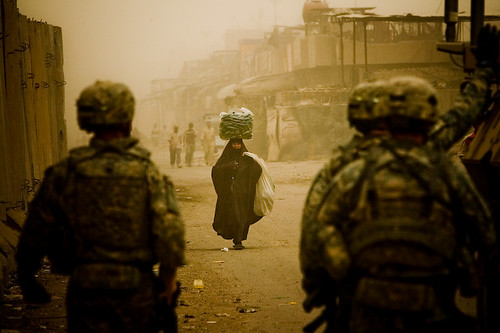
In February 2006 Al Qaeda bombed the al-Askari Mosque in Samarra, Iraq. The attack was Abu Musab al-Zarqawi's crowning achievement, setting off the bloodiest and most grisly phase of the civil war in Iraq. The escalation of the war and the brutal ethnic cleansing campaigns carried out by all sides helped to turn American public opinion decisively against the war and played no small role in the wins of the Democratic party in the November 2006 mid-term elections. While many inside and outside of Washington were finally ready to start looking for an exit, the Bush administration, its legacy already inescapably tied to the war in Iraq, decided to double down. President Bush announced the troop surge on January 10, 2007, and the additional troops began entering Iraq before the end of that month.
Midway through 2007 the levels of violence began to tail off, and by the end of the year attacks and casualties had fallen to their 2004-05 levels. In September 2007 General David Petraeus and Ambassador Ryan Crocker reported to Congress that while virtually none of the political objectives of the surge had been met, the military objectives of the surge were being met. Over the course of 2008, it became conventional wisdom among political talking heads of all stripes that, notwithstanding the failure to achieve the political objectives, the surge had succeeded. John McCain prevailed in the 2008 Republican primaries largely on the basis of having been a champion for the surge. Mainstream newspapers called out Democratic candidate Barack Obama for failing to admit that he had been wrong about the surge. And Obama, for his part, seemed content to support this conventional wisdom on the basis that if the surge had worked, then it must be time to bring the troops home. This conventional wisdom has been augmented by the fact that the decline in casualties and violence has generally taken Iraq off the front pages. For the past year the conflict has been largely out of sight and out of mind, which itself serves as evidence of the apparent success of the surge and also diminishes public discussion that might lead to challenges of the conventional wisdom.
Lately, however, something odd has started to happen. Thoughtful and serious people, with whom I often agree, are employing the apparent success of the surge as justification for a much longer term commitment to keeping troops in Iraq (e.g. Thomas Ricks and Andrew Sullivan). Let me put aside for the moment the fact that I don't believe that the surge was the primary cause for the decrease in violence in Iraq (in fact, it probably wasn't even the secondary cause). Even if we assume that the surge was solely responsible for the decline in violence, the fact that we are today not one iota closer to solving the basic structural political challenges of Iraq than we were three years ago should reveal the surge to all as the utter failure that it is. In truth it stands as a testament to the hollowness and stupidity of the entire endeavor in Iraq from day 1. The question of how to resolve the ethnic/sectarian divisions of Iraq was at the top of every critic's list of objections before the war started in 2003. Here we sit in 2009 and still no one has the first fucking clue how to resolve this problem. And yet Ricks and Sullivan would have us keep tens or hundreds of thousands of troops in Iraq for at least another 5 years in hopes that someone can pull a rabbit out of a hat and make everything better. I hate to be the one to break it to these fellas, it ain't gonna happen.
When I go back and look at what I wrote about Iraq two or three years ago, I see little that has occurred to change my evaluation. It's true that the decline in violence has bought us some time (although the levels of violence have been ticking up again, possibly in reaction to last month's elections). But time for what? There still appears to be little prospect for political reconciliation, meaning that whatever fallout will result from an American withdrawal will happen whether we withdraw this year or in 2015. And our presence in Iraq continues to cost us the lives of our servicemen and an immense amount of money, strain our military capacity and limit our effectiveness in Afghanistan, and hinder our efforts to repair relations with Arab and Muslim nations. The opportunity costs of remaining in Iraq are substantial, and the benefits of staying appear to be minimal. It's time to bring this misadventure to a close.
I remain of the opinion that we should be prepared to intervene again if things spiral too badly out of control, but I do not believe that we will see a serious effort towards political reconciliation until we force the issue by drawing down our forces. We have no better options than to try it and see what happens. The surge has not altered that equation. It has only delayed us, at significant cost, from asking the hard questions and making the hard decisions for the past two years. Now is the time to do what needs to be done.
Photo credit Zoriah
Saturday, February 21, 2009

The New Battleground for IPTV
The battle over net neutrality has always been, first and foremost, a battle about who gets to provide video services over the Internet. As such, I think that what just happened between Hulu and Boxee could have significant implications for the future of telecommunications in the US.
Spurred on by the massive success of YouTube, online video has made huge strides in recent years. We're now seeing multiple competing sources for online movies and TV. One of the last remaining hurdles for these providers to overcome is to make the move from consumers' computer monitors to their televisions. One potential route for this to happen is through gaming consoles. Another route is through dedicated hardware, basically a set-top box that connects to the Internet and serves videos. Boxee makes one such device. The key to commercial success for any such device is access to content, and Boxee had until recently been planning to get content from, among other sources, streaming video provider Hulu. Hulu carries content from numerous TV networks, including Fox, NBC, Comedy Central, PBS, and Sci Fi. One could imagine Boxee, with support for Hulu, Netflix, YouTube, and various other sources posing a legitimate threat to traditional cable and fiber video services (e.g. Comcast or FiOS).
The emergence of such a free-standing IPTV service would be an important development that could break the video content market wide open and end the stranglehold that the big cable companies and telcos currently have over it. So it is disturbing to see that the powers that control Hulu (Fox and NBC) nixed Hulu's deal with Boxee. I assume that the scenario played out more or less as Marc Hedlund describes in the article. But it's not entirely clear what the motivation of the content providers is here. I think Hedlund is probably right that the advertising contracts probably work differently for online viewing that for traditional TV viewing, and the the networks have some profit incentive to protect their TV advertising. But this should be a temporary limitation--as new contracts are entered or old contracts are renewed there is no reason why fee structures shouldn't be adjusted to reflect the new reality that Internet video may be viewed on TVs as well as computer monitors. And to that extent, one might think that the networks would have some interest in seeing Boxee get off the ground and build some viewership so that the networks would be able to turn around and sell access to those viewers to potential advertisers. Instead they seem inclined to strangle Boxee in the cradle.
It's possible this is just a negotiating tactic and the networks want to squeeze a few dollars out of Boxee before they acquiesce in the Boxee-Hulu deal. But it's also possible that there are greater philosophical differences at work. It could be that the networks are cozy with cable operators and the telcos (or are frightened of them) and don't want to rock the boat. Or that the networks are concerned about their future in a world of IPTV. There's really no such thing as a "channel" on IPTV. And what, exactly, is a television network with no channels? Ultimately I do think there would be an important role for the networks in an IPTV environment, something more akin to what movie studios do: picking potential projects, then financing, producing, and marketing them. But it would be a big change, and if we've learned anything from the struggles of old content industries on the Internet so far it's that big incumbents are extremely resistant to embracing change. Additionally, even though the networks will still be important in an IPTV universe, they will certainly be subject to new competition. It would be far cheaper and easier for independently produced content to gain an audience via IPTV than it is in the traditional video market.
In any case, if the networks are inclined to fight IPTV, they are in position to set back its progress considerably. Without major network support, IPTV is likely doomed to being a supplementary service to traditional video rather than a direct competitor with it. This would be a bad result for consumers and a bad result for both the telecom market and the video content market, but sadly I'm not sure that it is irrational from the standpoint of the networks. I'm also not sure, at this point, that there is much that can be done from a regulatory standpoint to push the networks towards IPTV, but we should be on the lookout for opportunities to do so.
Spurred on by the massive success of YouTube, online video has made huge strides in recent years. We're now seeing multiple competing sources for online movies and TV. One of the last remaining hurdles for these providers to overcome is to make the move from consumers' computer monitors to their televisions. One potential route for this to happen is through gaming consoles. Another route is through dedicated hardware, basically a set-top box that connects to the Internet and serves videos. Boxee makes one such device. The key to commercial success for any such device is access to content, and Boxee had until recently been planning to get content from, among other sources, streaming video provider Hulu. Hulu carries content from numerous TV networks, including Fox, NBC, Comedy Central, PBS, and Sci Fi. One could imagine Boxee, with support for Hulu, Netflix, YouTube, and various other sources posing a legitimate threat to traditional cable and fiber video services (e.g. Comcast or FiOS).
The emergence of such a free-standing IPTV service would be an important development that could break the video content market wide open and end the stranglehold that the big cable companies and telcos currently have over it. So it is disturbing to see that the powers that control Hulu (Fox and NBC) nixed Hulu's deal with Boxee. I assume that the scenario played out more or less as Marc Hedlund describes in the article. But it's not entirely clear what the motivation of the content providers is here. I think Hedlund is probably right that the advertising contracts probably work differently for online viewing that for traditional TV viewing, and the the networks have some profit incentive to protect their TV advertising. But this should be a temporary limitation--as new contracts are entered or old contracts are renewed there is no reason why fee structures shouldn't be adjusted to reflect the new reality that Internet video may be viewed on TVs as well as computer monitors. And to that extent, one might think that the networks would have some interest in seeing Boxee get off the ground and build some viewership so that the networks would be able to turn around and sell access to those viewers to potential advertisers. Instead they seem inclined to strangle Boxee in the cradle.
It's possible this is just a negotiating tactic and the networks want to squeeze a few dollars out of Boxee before they acquiesce in the Boxee-Hulu deal. But it's also possible that there are greater philosophical differences at work. It could be that the networks are cozy with cable operators and the telcos (or are frightened of them) and don't want to rock the boat. Or that the networks are concerned about their future in a world of IPTV. There's really no such thing as a "channel" on IPTV. And what, exactly, is a television network with no channels? Ultimately I do think there would be an important role for the networks in an IPTV environment, something more akin to what movie studios do: picking potential projects, then financing, producing, and marketing them. But it would be a big change, and if we've learned anything from the struggles of old content industries on the Internet so far it's that big incumbents are extremely resistant to embracing change. Additionally, even though the networks will still be important in an IPTV universe, they will certainly be subject to new competition. It would be far cheaper and easier for independently produced content to gain an audience via IPTV than it is in the traditional video market.
In any case, if the networks are inclined to fight IPTV, they are in position to set back its progress considerably. Without major network support, IPTV is likely doomed to being a supplementary service to traditional video rather than a direct competitor with it. This would be a bad result for consumers and a bad result for both the telecom market and the video content market, but sadly I'm not sure that it is irrational from the standpoint of the networks. I'm also not sure, at this point, that there is much that can be done from a regulatory standpoint to push the networks towards IPTV, but we should be on the lookout for opportunities to do so.
Brad DeLong Takes a Stand
Brad DeLong, econ professor at Berkley (and respected blogger) has written a letter to the school's administration requesting that it terminate the employment of law professor John Yoo. I thank him for it, and hope others will join him. I've found it quite disturbing for several years now that Yoo has been treated as a respectable and important member of the legal academia. The man should count himself lucky that he is not in prison for war crimes and have the good sense to otherwise remain out of sight. DeLong's letter is well worth reading. The actions Yoo took for the Bush administration were blatantly unethical, and a lot of people suffered and died behind the bogus legal cover he provided the administration. He is an embarrassment to the school and the profession. And that's to say nothing of Jay Bybee sitting on the 9th Circuit.
Being a Bully Isn't the Best Bet
First, I should note that I have been greatly enjoying Foreign Policy mag's expanded blogger lineup (Tom Ricks, Dan Drezner, Stephen Walt, and Marc Lynch). It's quite an impressive group of analysts, and part of my regular reading routine these days. Walt recently pointed out a great paper on international relations by Todd Sechser. Walt summarizes it as follows:
[G]reat powers often fail to get their way when they issue coercive threats (which is surprising at first glance), and that this problem may in fact get worse the more powerful they are. The basic logic here concerns reputation: weak states will worry about giving in to a great power’s demands (even when the demands are fairly minor), because they will fear that the great power will just demand more later. So they resist now, to enhance their reputation for being stubborn and to convince the great power to leave them alone in the future. The core of the problem is that a very powerful state can’t make a credible commitment of restraint; it can’t reassure the weak state that it really, truly, wants just a modest concession, one that the weak state might be willing to grant if it were confident that this would be the only demand. And the bigger and stronger the coercing state is, the harder it is for that state to reassure the weak power that its aims are actually limited.It's not a shock that coercive threats against other states are generally unsuccessful (I think that's been a semi-regular theme of foreign policy discussions on this blog), but I think the point about being able to credibly commit to restraint is useful. This is one of the great values of international institutions. It has long been fashionable for conservatives (generally, but often liberals too) to scoff at the UN for hindering our ability to get things done. Ironically, the fact that working through institutions like the UN does to some extent tie our hands can make them more useful. A commitment to work through institutions in which our actions are restrained and other parties have meaningful voice makes our actions less threatening and more constructive.
Wednesday, February 18, 2009
Silver on Progressivism
So I have to concede that after having been a serious Nate Silver junkie throughout the election season, I hardly looked at 538.com for a couple of months after the election was over. Increasingly, however, I've been drawn back as a regular reader. I think this post goes a long way to explaining why. I have from time to time expressed a certain amount of frustration with the liberal bloggers and netroots (as here or here). The online liberal community seems to have a heavy tilt towards economic populism and hyper-partisan demagoguery that I tend to find repellent. Some of the more prominent bloggers (e.g. Matt Yglesias) are lighter on the economic populism, but still tend to be heavy-handed partisan footsoldiers. Silver comes closer to mirroring my own views than any of the other bloggers I currently read. The discussion at 538.com linked above does a pretty good job of sorting out the differences. Like Silver, Obama clearly falls into the "rational progressive" category--in fact, he probably represents the prototypical ideal of rational progressivism. I expect we'll see plenty of argument over the next 4 or 8 years between the rational progressives and the radical progressives over the direction of the Obama administration. At least I hope so, because the conservatives are, frankly, too stupid to bother arguing with lately.
Wednesday, December 10, 2008
Good Quote
I was just listening to some lectures on the Birth of the Modern Mind in the background while working on a take home exam from one of my Stats classes when I heard this quote.
I thought it bore (indirectly admittedly) on the relation between commercialism and religious tolerance. I've been thinking a good bit on the idea that economic and commercial freedom and the prosperity that tends to accompany them have been the driving force behind the rise of political freedom and civil rights. So the quote just kind of struck me. Anyway, back to work.Though the Episcopal and Presbyterian sects are the two prevailing ones in Great Britain, yet all others are very welcome to come and settle in it, and live very sociably together, though most of their preachers hate one another almost as cordially as a Jansenist damns a Jesuit.
Take a view of the Royal Exchange in London, a place more venerable than many courts of justice, where the representatives of all nations meet for the benefit of mankind. There the Jew, the Mahometan, and the Christian transact together, as though they all professed the same religion, and give the name of infidel to none but bankrupts. There the Presbyterian confides in the Anabaptist, and the Anglican depends on the Quaker's word. At the breaking up of this pacific and free assembly, some withdraw to the synagogue, and others to take a glass. This man goes and is baptized in a great tub, in the name of the Father, Son, and Holy Ghost: that man has his son's foreskin cut off, whilst a set of Hebrew words (quite unintelligible to him) are mumbled over his child. Others retire to their churches, and there wait for the inspiration of heaven with their hats on, and all are satisfied.
If there were only one religion in England, there would be despotism to fear; if there were but two, they would cut one another's throats; but there are thirty, and they live happily and in peace.
Voltaire, "Letters on the English" c. 1778
Tuesday, November 25, 2008
Some More Rawls Discussion
Speaking of meritorious blogging content, someone smart must have submitted this email to Andrew Sullivan. :) Having appeared on Fallows' blog some time ago, I wonder if this qualifies me as an Atlantic Monthly groupie.
The Brave New Media World
Henry,
You raise a few interesting points. First, I would just note that your major premise is one that we've discussed a few times at Boys' events, although I can't recall whether you've been present for any of those discussions. It was the subject of a short but prescient book by Cass Sunstein titled Republic.com. He argued, precisely as you have, that proliferation in media sources will fuel self-selection of sources that confirm preexisting biases, undermining our cultural common ground and fragmenting our social beliefs. I think the threat is real, but can be overstated (as I'll discuss further below).
Second, I know exactly what you're talking about with regards to the comment sections on news sites. That stuff is purely toxic. It's even worse than you find on the purely partisan blogs and forums (e.g. DailyKos or RedState). News sites and YouTube comment threads and things of that nature appear to draw the absolute dregs for commenters. It's disturbing to read it, but ultimately I don't think that amounts to much. I suspect that it really is a very small percentage of the people who read the news stories or watch videos who post those comments (and probably with a high percentage of repeat players from one site to another). The numbers of people who participate in sites like DailyKos and RedState are more significant. Of course, those people also tend to suffer from groupthink and hyperbole and certainly represent a fragmentation in worldviews. But again, I'm not yet convinced that this is especially problematic. Their influence is ultimately fairly limited, as each party's Presidential primary this year demonstrated. In both cases the netroots favorites (Edwards for the Democrats, anybody-but-McCain (Ron Paul?) for the Republicans) failed to win.
Ultimately I think the democratization of public discourse via the Internet has been a tremendous win for the public. Contrary to your contention that we've seen a disappearance of sincere public discourse, I think we're seeing the emergence of new and important avenues for public discourse. There is a dialogue taking place on a community of blogs that surpasses in intelligence and candidness anything I can recall from the pre-Internet (or early Internet) days. To name just a few: Andrew Sullivan, Obsidian Wings, Matt Yglesias, Nate Silver, Al Giordano, Dan Drezner, Greg Djerejian, Ezra Klein, Tyler Cowen, John Cole, Cunning Realist, Josh Marshall. This short list covers a pretty broad spectrum of opinions (and certainly there are many others out there). These people are intelligent, generally well-educated, have diverse areas of expertise, and are interested in honest and sincere dialogue. Better yet, many of them read one another (and many other bloggers) and actually engage in back-and-forth discussion.
While the readership of the blogging community is still not at the same level as traditional media consumption, I think its influence is considerable. The bigger blogs (Sullivan, Marshall) draw in the neighborhood of a million page views a day, which is not insignificant. Moreover, that readership is disproportionately drawn from politicians (or at least political staffers), policymakers, and the media. This blogging community has the ability to affect campaign narratives. I think this is one of the reasons the McCain campaign flailed so wildly from one narrative to another over the Summer and Fall. The McCain strategists, all Karl Rove proteges, couldn't understand why their Obama narratives were not sticking the way the Al Gore - fibber and John Kerry - aloof liberal narratives stuck. The bloggers ripped their idiotic narratives to shreds and were quick to pounce if the traditional media went too far astray.
The emergence of this community presents a challenge to Sunstein's predictions. Certainly there is plenty of evidence on the Internet of Sunstinian self-selection and reinforcement of biases. But there is also a conscious acknowledgment among others that in order to be relevant as a thinker and a political writer one must be willing to inhabit the same world as other writers and one must be willing to engage differing views on more than a superficial level. Certainly this creates some tension between the self-reinforcing Freepers and Kossacks and the reality-based bloggers. On the conservative side this tension has spilled over into something like open warfare with the Freepers and Redstaters attempting to expel any conservatives who do not fully acquiesce in the Bush/Rove Republican orthodoxy. It's not clear how this is going to play out, although it seems inevitable that it will end badly for the Freepers, who are at this point quite remote from reality.
To conclude, I think, Henry, that you and Sunstein both had useful insights into the impact of hugely diverse media landscape, but I think the danger here is easily overstated. The broad expansion of the media landscape has occurred because the barriers to publication have dropped to almost nil (case in point: the Boys Weekend Journal), and the elimination of these barriers has also had tremendously positive effects. It does require people to be more savvy in their consumption of, and interaction with, the news, but the Internet has also made a great many people far more savvy about news media than the public has previously been. And the ease of entry into the market and the ease with which consumers can move from one product to another has allowed for something much closer to a true meritocracy than has ever existed in the traditional media. Nate Silver could never have gone from obscure bystander to political media powerhouse in less than a year in the old media market. I would go so far as to say we are entering a renaissance of political discourse. But the interplay between substantial number of people who have defied Sunstein's expectations with the still considerable masses who have conformed to his expectations does warrant continued observation. While relations between the two groups may frequently be strained, I think by virtue of pure merit alone the reality-based bloggers will always remain relevant and important.
You raise a few interesting points. First, I would just note that your major premise is one that we've discussed a few times at Boys' events, although I can't recall whether you've been present for any of those discussions. It was the subject of a short but prescient book by Cass Sunstein titled Republic.com. He argued, precisely as you have, that proliferation in media sources will fuel self-selection of sources that confirm preexisting biases, undermining our cultural common ground and fragmenting our social beliefs. I think the threat is real, but can be overstated (as I'll discuss further below).
Second, I know exactly what you're talking about with regards to the comment sections on news sites. That stuff is purely toxic. It's even worse than you find on the purely partisan blogs and forums (e.g. DailyKos or RedState). News sites and YouTube comment threads and things of that nature appear to draw the absolute dregs for commenters. It's disturbing to read it, but ultimately I don't think that amounts to much. I suspect that it really is a very small percentage of the people who read the news stories or watch videos who post those comments (and probably with a high percentage of repeat players from one site to another). The numbers of people who participate in sites like DailyKos and RedState are more significant. Of course, those people also tend to suffer from groupthink and hyperbole and certainly represent a fragmentation in worldviews. But again, I'm not yet convinced that this is especially problematic. Their influence is ultimately fairly limited, as each party's Presidential primary this year demonstrated. In both cases the netroots favorites (Edwards for the Democrats, anybody-but-McCain (Ron Paul?) for the Republicans) failed to win.
Ultimately I think the democratization of public discourse via the Internet has been a tremendous win for the public. Contrary to your contention that we've seen a disappearance of sincere public discourse, I think we're seeing the emergence of new and important avenues for public discourse. There is a dialogue taking place on a community of blogs that surpasses in intelligence and candidness anything I can recall from the pre-Internet (or early Internet) days. To name just a few: Andrew Sullivan, Obsidian Wings, Matt Yglesias, Nate Silver, Al Giordano, Dan Drezner, Greg Djerejian, Ezra Klein, Tyler Cowen, John Cole, Cunning Realist, Josh Marshall. This short list covers a pretty broad spectrum of opinions (and certainly there are many others out there). These people are intelligent, generally well-educated, have diverse areas of expertise, and are interested in honest and sincere dialogue. Better yet, many of them read one another (and many other bloggers) and actually engage in back-and-forth discussion.
While the readership of the blogging community is still not at the same level as traditional media consumption, I think its influence is considerable. The bigger blogs (Sullivan, Marshall) draw in the neighborhood of a million page views a day, which is not insignificant. Moreover, that readership is disproportionately drawn from politicians (or at least political staffers), policymakers, and the media. This blogging community has the ability to affect campaign narratives. I think this is one of the reasons the McCain campaign flailed so wildly from one narrative to another over the Summer and Fall. The McCain strategists, all Karl Rove proteges, couldn't understand why their Obama narratives were not sticking the way the Al Gore - fibber and John Kerry - aloof liberal narratives stuck. The bloggers ripped their idiotic narratives to shreds and were quick to pounce if the traditional media went too far astray.
The emergence of this community presents a challenge to Sunstein's predictions. Certainly there is plenty of evidence on the Internet of Sunstinian self-selection and reinforcement of biases. But there is also a conscious acknowledgment among others that in order to be relevant as a thinker and a political writer one must be willing to inhabit the same world as other writers and one must be willing to engage differing views on more than a superficial level. Certainly this creates some tension between the self-reinforcing Freepers and Kossacks and the reality-based bloggers. On the conservative side this tension has spilled over into something like open warfare with the Freepers and Redstaters attempting to expel any conservatives who do not fully acquiesce in the Bush/Rove Republican orthodoxy. It's not clear how this is going to play out, although it seems inevitable that it will end badly for the Freepers, who are at this point quite remote from reality.
To conclude, I think, Henry, that you and Sunstein both had useful insights into the impact of hugely diverse media landscape, but I think the danger here is easily overstated. The broad expansion of the media landscape has occurred because the barriers to publication have dropped to almost nil (case in point: the Boys Weekend Journal), and the elimination of these barriers has also had tremendously positive effects. It does require people to be more savvy in their consumption of, and interaction with, the news, but the Internet has also made a great many people far more savvy about news media than the public has previously been. And the ease of entry into the market and the ease with which consumers can move from one product to another has allowed for something much closer to a true meritocracy than has ever existed in the traditional media. Nate Silver could never have gone from obscure bystander to political media powerhouse in less than a year in the old media market. I would go so far as to say we are entering a renaissance of political discourse. But the interplay between substantial number of people who have defied Sunstein's expectations with the still considerable masses who have conformed to his expectations does warrant continued observation. While relations between the two groups may frequently be strained, I think by virtue of pure merit alone the reality-based bloggers will always remain relevant and important.
Monday, November 03, 2008
Is a secular "church" a legal possibility?
I've wondered about this for quite a while and I figured I'd put the question to you guys as legal experts.
The idea really became well formed in my mind when I was working on the printing press and would regularly read a Jewish newsletter for the Chicago area that we ran. It set me thinking about how valuable a resource a religious organization can be for it's members. They're really excellent models for how many non-market-based services can be provided outside of state action.
Prior to the major involvement of the state in things like charity (welfare), education, and health care, religious organizations were the major providers of these services. To some degree they still do provide these sorts of services and others which the state does not provide, such as social networking and adult education.
So, could you create a secular, tax-exempt, organization that has a set philosophy (humanistic, for instance) which provides adult education, social activities, private schools, scholarship funds, recreational facilities, counseling, etc., exclusively to members?
The idea really became well formed in my mind when I was working on the printing press and would regularly read a Jewish newsletter for the Chicago area that we ran. It set me thinking about how valuable a resource a religious organization can be for it's members. They're really excellent models for how many non-market-based services can be provided outside of state action.
Prior to the major involvement of the state in things like charity (welfare), education, and health care, religious organizations were the major providers of these services. To some degree they still do provide these sorts of services and others which the state does not provide, such as social networking and adult education.
So, could you create a secular, tax-exempt, organization that has a set philosophy (humanistic, for instance) which provides adult education, social activities, private schools, scholarship funds, recreational facilities, counseling, etc., exclusively to members?
Election 2008 -- Viewing Guide
I've collected a few sites to check on election night as the polls come in.
First, here's Nate Silver on what to watch for.
Here are the poll closing times:

Intrade's realtime electoral vote predictor:
CNN Election Center:
MSNBC results:
First, here's Nate Silver on what to watch for.
Here are the poll closing times:

Intrade's realtime electoral vote predictor:
CNN Election Center:
MSNBC results:
Monday, October 27, 2008
American Politics
I was just watching a very good MIT panel on Media coverage of the presidential election when I heard a quote (1:56:50) I just had to transcribe and post here. John Carroll says:
I don't own a TV, and I don't feel that either of the major parties comes comes close to representing me, so I haven't been following the election closely. I do however do some occasional reading at the Economist, the Atlantic, and elsewhere. What has gradually given me this creeping, skin crawling, feeling that political discourse has fallen into the abyss, is reading the comments which are ubiquitously attached to online articles. These pain me deeply.
I've been a long time user of the internet. Trolling and flaming on boards, forums, and news sites are nothing new to me. That is, I have a baseline. Yet, of late, I've found the comments on site like those I mentioned above to be particularly discouraging. A very high percentage of comments are incredibly hostile, loaded with vitriol and ad hominem attacks. It really doesn't depend on the article. Left or Right leaning articles tend to draw the predictable attacks from the opposing side (though it's disappointing that these are being phrased less and less in constructive and reasonable ways), but the really scary thing is that the articles that draw the most fire are those that take a neutral or centrist position. That is, the sides have become so polarized that any viewpoint that does not openly align with one camp or the other is fair game for vicious assaults from both.
The above panel helped me to think about why this is happening. The proliferation of the media, the creation of new cable channels and the new media, while adding depth and breadth to the discourse available to the average media consumer, has actually had a tendency to narrow their field of view. There are so many sources of information from any given perspective that a person can read many blogs and news sites, and watch several political TV shows while never actually exposing themselves any alternative viewpoints. While, a few decades ago, there may have only been a handful choices in terms of channels and papers, the very universality of these media sources required that they cater to both sides of the political divide. Today's media sources are so extensively diversified that we can each choose to steep in a carefully selected set of opinions that precisely support the very perspective that we have already chosen to adhere to.
My gut feeling is that this is leading us toward further calamity. I think that this trend toward polarization and the disappearance of sincere public discussion and debate has been underway for some time. I think our current circumstances (the Iraq war and the financial crises, the biggest political and economic disasters in recent memory) are the fruits of this trend. We are reaping disaster, and yet what we are sowing today is far more corrupted and virulent than the seeds that brought us our current sorrows.
I think this relates to what I have described in the past as the anthropomorphization of our problems. That is, we tend to blame the problems we see on the direct action and intention of other people. We implicitly believe that, if we can counteract the actions of these evil people, we can undo the problems of the world. Hence it makes sense to mobilize the base of our party at whatever cost. In our all out war we sacrifice the truth for political expediency. But if the problems are in fact much more complicated than we appreciate, the ends do not justify the means. In fact, the means do not lead us to our ends at all, but rather to folly and destruction.
I would like to think that actual reasoned conversation and argument might actually have some effect on people's perceptions and how they vote. I mean, that would be a giant step forward I think. But I'm not sure that's actually going to happen because the two sides have hardened so much. I think Tom [Rosenstiel] writes about this in his book, that there used to be a shared set of facts that people would argue from. They would agree on some basic facts and then, they would argue from there. I think people don't agree on basic facts anymore and I don't think that anybody allows for the possibility that someone who disagrees with them can have a reasonable point of view, a legitimate point of view. I think it's all about delegitimizing the opposition. I think that that makes a very hard dynamic for anything positive to happen.This inspired me to make a post I've been meaning to add for some time. I've been feeling more and more in the past couple of months that the political climate in the US is becoming fatally ossified and polarized. Political discussion seems to be pretty much dead.
I don't own a TV, and I don't feel that either of the major parties comes comes close to representing me, so I haven't been following the election closely. I do however do some occasional reading at the Economist, the Atlantic, and elsewhere. What has gradually given me this creeping, skin crawling, feeling that political discourse has fallen into the abyss, is reading the comments which are ubiquitously attached to online articles. These pain me deeply.
I've been a long time user of the internet. Trolling and flaming on boards, forums, and news sites are nothing new to me. That is, I have a baseline. Yet, of late, I've found the comments on site like those I mentioned above to be particularly discouraging. A very high percentage of comments are incredibly hostile, loaded with vitriol and ad hominem attacks. It really doesn't depend on the article. Left or Right leaning articles tend to draw the predictable attacks from the opposing side (though it's disappointing that these are being phrased less and less in constructive and reasonable ways), but the really scary thing is that the articles that draw the most fire are those that take a neutral or centrist position. That is, the sides have become so polarized that any viewpoint that does not openly align with one camp or the other is fair game for vicious assaults from both.
The above panel helped me to think about why this is happening. The proliferation of the media, the creation of new cable channels and the new media, while adding depth and breadth to the discourse available to the average media consumer, has actually had a tendency to narrow their field of view. There are so many sources of information from any given perspective that a person can read many blogs and news sites, and watch several political TV shows while never actually exposing themselves any alternative viewpoints. While, a few decades ago, there may have only been a handful choices in terms of channels and papers, the very universality of these media sources required that they cater to both sides of the political divide. Today's media sources are so extensively diversified that we can each choose to steep in a carefully selected set of opinions that precisely support the very perspective that we have already chosen to adhere to.
My gut feeling is that this is leading us toward further calamity. I think that this trend toward polarization and the disappearance of sincere public discussion and debate has been underway for some time. I think our current circumstances (the Iraq war and the financial crises, the biggest political and economic disasters in recent memory) are the fruits of this trend. We are reaping disaster, and yet what we are sowing today is far more corrupted and virulent than the seeds that brought us our current sorrows.
I think this relates to what I have described in the past as the anthropomorphization of our problems. That is, we tend to blame the problems we see on the direct action and intention of other people. We implicitly believe that, if we can counteract the actions of these evil people, we can undo the problems of the world. Hence it makes sense to mobilize the base of our party at whatever cost. In our all out war we sacrifice the truth for political expediency. But if the problems are in fact much more complicated than we appreciate, the ends do not justify the means. In fact, the means do not lead us to our ends at all, but rather to folly and destruction.
Saturday, October 18, 2008
Sunday, September 07, 2008
The Republican Strategy: Straight from Sesame Street
For some time, I have been meaning to post a couple of thoughts I had after reading The Obama Nation: Leftist Politics and the Cult of Personality. At the time, I was worried that the book would launch a wave of attacks similar to those that hit Kerry in 2004. Thankfully, that didn't happen--largely due to prompt responses by the Obama campaign and supporters. The media has since moved on to other things (e.g., Palin-mania), but I wanted to get my points out there anyway.
The book epitomizes two of the things that trouble me deeply about politics today, particularly as it is played by the core of the Republican party (aka, the "religious right"). First is the abuse of science and academics to prop up completely bogus claims. "Dr. Corsi," and others in his camp, attempt to mimic the methods of scientists and academics but ignore the most critical aspects of those disciplines (such as refutability in science), in a blatant attempt to support their own views rather than to discover the truth. Second, there is a subtextual campaign to divide the world into "us" and "them," with McCain-Palin in the "us" camp and Obama belonging to "them." You remember the Sesame Street song that goes, "One of these things is not like the others; one of these things just doesn't belong ..."? That about sums up the theme of The Obama Nation, and for that matter the entire Republican strategy this election season. (Though in all fairness, I don't think that's the message that the Cookie Monster was promoting.)
The book epitomizes two of the things that trouble me deeply about politics today, particularly as it is played by the core of the Republican party (aka, the "religious right"). First is the abuse of science and academics to prop up completely bogus claims. "Dr. Corsi," and others in his camp, attempt to mimic the methods of scientists and academics but ignore the most critical aspects of those disciplines (such as refutability in science), in a blatant attempt to support their own views rather than to discover the truth. Second, there is a subtextual campaign to divide the world into "us" and "them," with McCain-Palin in the "us" camp and Obama belonging to "them." You remember the Sesame Street song that goes, "One of these things is not like the others; one of these things just doesn't belong ..."? That about sums up the theme of The Obama Nation, and for that matter the entire Republican strategy this election season. (Though in all fairness, I don't think that's the message that the Cookie Monster was promoting.)
Saturday, August 23, 2008
Lessig on Technology Policy
Here, in just over 15 minutes, Larry Lessig says basically everything I've ever tried to say about telecom policy on the blog (in the context of a critique of John McCain's tech platform). Take a look, it's well worth the time:
Also, for a number of weeks I've been meaning to post a link to this ars technica article on customer-owned fiber. Projects like this, or like Utah's UTOPIA seem to present the best way forward for the domestic telecom market.
Also, for a number of weeks I've been meaning to post a link to this ars technica article on customer-owned fiber. Projects like this, or like Utah's UTOPIA seem to present the best way forward for the domestic telecom market.
Monday, July 28, 2008
A Gaffe That Draws Blood
I have to concede, I am really quite pleased that John McCain started running his mouth about the Anbar Awakening. Before he did, the Conventional Wisdom on the Surge was so firmly established as to appear immovable. Everybody knows, the Surge worked. The fact that there is very little evidence to support that assertion really never came up. And if anyone tried to bring it up, they were scoffed at (as Obama was in the USA Today editorial above). Now that McCain has brought to the fore the fact that the Anbar Awakening, one of the most critical elements of our recent success in Iraq, was unrelated to the Surge, we can start to revisit the Conventional Wisdom.
What I think we'll find is that the real root cause for the turnaround in violence in Iraq had less to do with the additional 20,000 troops than with a change in tactics of which the Anbar Awakening was one element. The dramatic rise of David Petraeus marked the military's final grudging acceptance of the need to engage in actual counterinsurgency operations. After several disastrous years fighting the insurgency, it dawned on the Pentagon that their only real successes came where officers like Petraeus and H.R. McMaster eschewed the major operations that were up to that point the mainstay of the Iraq occupation and adopted classic counterinsurgency tactics. Hell, Petraeus wrote the book on the topic. Petraeus's ascension and this shift in tactics is what made the Anbar Awakening and the later success of the Surge possible.
This is a fairly important distinction, for a couple of reasons. First, is its obvious political impact. McCain has staked much on the fact that he supported the Surge when few others did, and the apparent success of the Surge is supposed to justify any number of prior errors of judgment with respect to Iraq (note how the USA Today article asks Obama to admit he was wrong about the surge, but it doesn't ask McCain to admit he was wrong about invading). If the Surge was not the answer, what does McCain have left to hang his hat on? Even if McCain did back counterinsurgency tactics, and it's not clear he did, that wouldn't be a terribly unique position. This humble blogger criticized the major ops approach to fighting the insurgency as far back as 2003, called for the implementation of counterinsurgency tactics in early 2004, and praised the military's movement in that direction in late 2005. Where was McCain all that time? I could have used his help back then.
Aside from the 2008 election, this debate has other long-term implications. Crediting the Surge for all that has gone right serves the right-wing's ever-popular Green Lantern Theory of Foreign Policy. According to the Green Lantern Theory ("GLT") any military failure is caused by a lack of willpower, and any military objective is achievable given a sufficient reserve of willpower. A corollary to the GLT is that any domestic criticism of either the decision to engage in a military conflict or the conduct of such conflict is a direct attack on the one resource necessary to win such a conflict (willpower) and thereby equivalent to treason. Proponents of the GLT have long scorned concepts such as nationbuilding, the exercise military restraint, respect for local culture, winning of hearts and minds, and, indeed, just about every other element of a traditional counterinsurgency operation. Not only are such things considered to be pointless, but they might weaken our resolve and are therefore deemed harmful to the cause.
Pinning all success in Iraq to the Surge is a perfect narrative fit for the GLT. Just when everyone else wanted to discuss withdrawal, George W. Bush rode the rescue with bulging reserves of willpower and not only refused to withdraw, he upped the ante as a tangible demonstration of his generous endowment of resolve. And lo, victory was achieved. If this is the narrative that comes out of the Iraq war, we will all live to regret it. The United States and Iraq alike paid a painful and bloody price to learn the lessons that the GLT proponents hope to obscure in a haze of Surge-o-philia.
In truth what we learned this time around are a lot of the lessons we should have learned from Vietnam. Indeed, Robert McNamara basically did learn those lessons. It is no coincidence that so did David Petraeus and H.R. McMaster. Petraeus wrote a doctoral thesis at Princeton titled "The American Military and the Lessons of Vietnam." McMaster also wrote a doctoral thesis on the mistakes of the American military in Vietnam. The lessons were there to be learned, but few among conservative policymakers and the Pentagon brass did, enamored of the GLT as they are. Will we walk away from Iraq with the public and policymakers learning all the same wrong lessons so that the next time around we will, at terrible cost, have to rediscover the right ones all over again? I surely hope not. And I hope that McCain's gaffe will open the door to a more robust public dialogue on this topic.
What I think we'll find is that the real root cause for the turnaround in violence in Iraq had less to do with the additional 20,000 troops than with a change in tactics of which the Anbar Awakening was one element. The dramatic rise of David Petraeus marked the military's final grudging acceptance of the need to engage in actual counterinsurgency operations. After several disastrous years fighting the insurgency, it dawned on the Pentagon that their only real successes came where officers like Petraeus and H.R. McMaster eschewed the major operations that were up to that point the mainstay of the Iraq occupation and adopted classic counterinsurgency tactics. Hell, Petraeus wrote the book on the topic. Petraeus's ascension and this shift in tactics is what made the Anbar Awakening and the later success of the Surge possible.
This is a fairly important distinction, for a couple of reasons. First, is its obvious political impact. McCain has staked much on the fact that he supported the Surge when few others did, and the apparent success of the Surge is supposed to justify any number of prior errors of judgment with respect to Iraq (note how the USA Today article asks Obama to admit he was wrong about the surge, but it doesn't ask McCain to admit he was wrong about invading). If the Surge was not the answer, what does McCain have left to hang his hat on? Even if McCain did back counterinsurgency tactics, and it's not clear he did, that wouldn't be a terribly unique position. This humble blogger criticized the major ops approach to fighting the insurgency as far back as 2003, called for the implementation of counterinsurgency tactics in early 2004, and praised the military's movement in that direction in late 2005. Where was McCain all that time? I could have used his help back then.
Aside from the 2008 election, this debate has other long-term implications. Crediting the Surge for all that has gone right serves the right-wing's ever-popular Green Lantern Theory of Foreign Policy. According to the Green Lantern Theory ("GLT") any military failure is caused by a lack of willpower, and any military objective is achievable given a sufficient reserve of willpower. A corollary to the GLT is that any domestic criticism of either the decision to engage in a military conflict or the conduct of such conflict is a direct attack on the one resource necessary to win such a conflict (willpower) and thereby equivalent to treason. Proponents of the GLT have long scorned concepts such as nationbuilding, the exercise military restraint, respect for local culture, winning of hearts and minds, and, indeed, just about every other element of a traditional counterinsurgency operation. Not only are such things considered to be pointless, but they might weaken our resolve and are therefore deemed harmful to the cause.
Pinning all success in Iraq to the Surge is a perfect narrative fit for the GLT. Just when everyone else wanted to discuss withdrawal, George W. Bush rode the rescue with bulging reserves of willpower and not only refused to withdraw, he upped the ante as a tangible demonstration of his generous endowment of resolve. And lo, victory was achieved. If this is the narrative that comes out of the Iraq war, we will all live to regret it. The United States and Iraq alike paid a painful and bloody price to learn the lessons that the GLT proponents hope to obscure in a haze of Surge-o-philia.
In truth what we learned this time around are a lot of the lessons we should have learned from Vietnam. Indeed, Robert McNamara basically did learn those lessons. It is no coincidence that so did David Petraeus and H.R. McMaster. Petraeus wrote a doctoral thesis at Princeton titled "The American Military and the Lessons of Vietnam." McMaster also wrote a doctoral thesis on the mistakes of the American military in Vietnam. The lessons were there to be learned, but few among conservative policymakers and the Pentagon brass did, enamored of the GLT as they are. Will we walk away from Iraq with the public and policymakers learning all the same wrong lessons so that the next time around we will, at terrible cost, have to rediscover the right ones all over again? I surely hope not. And I hope that McCain's gaffe will open the door to a more robust public dialogue on this topic.
Sunday, July 13, 2008
Too Big to Be Privatized
There has been buzz for the past several days that the federal government would move to bail out Fannie Mae and Freddie Mac, and now appears the rumors have proven correct. This follows not so long after the bailout of Bear Stearns. I don't know enough about the banking market to say whether the government has made the right moves with respect to these bailouts, but it strikes me as odd that any private entity should be considered "too big to fail". It seems there two potential routes around this: either ensure that no single firm in a given market obtains enough market share to make its collapse catastrophic, or simply put the critical functions under public control. The former option is problematic in that a) it would require a far more robust (and I mean FAR more) and aggressive type of antitrust regulation than we currently have, and b) it is easy to imagine that, even with a larger number of firms, intense competition might lead the firms to adopt similar approaches such that numerous firms would teeter on the edge of collapse at the same time, and a bailout would be required anyway. The latter option is problematic for the obvious reason that markets are generally more efficient than government management. But this system where private companies are free to reap really impressive profits (as the investment banks have), but the public ultimately bears the downside risk seems untenable.
This problem has always been at the foundation of my opposition to any sort of privatization of social security. In fact, it's worse for social security than for the banking system, because with social security you've got two levels risk to deal with--the institutional and individual. Because even if whatever private institutions we hand the system over to don't fail, if a significant number of individuals managed their risk poorly and get cleaned out, I find it inconceivable that the government wouldn't step in to rescue them. That is, after all, the entire point of the program. It's social security. And once that happens, of course we'd expect everyone else to try to shoot the moon with their investments, because what's the downside? This is the sort of risk we don't want to be distributed. It only works when the risk is pooled. Look for similar problems with some sort of hybridized public/private health insurance. Once we've made a social decision that some service is necessary, for whatever reason (economic stability, national security, moral obligation), handing it over to private entities will necessarily create serious problems with risk management and moral hazard.
I'm not necessarily arguing that, for example, our entire banking system or health care system should be government run. But I do think that in terms of structuring the mix of government and private management of such critical functions we need to try to identify key breaking points and either put them under direct government control or develop some clever system to ensure that private entities approach these functions with the right set of incentives.
Update (7/14): Sebastian Mallaby appears to have a similar take on the issue to mine.
This problem has always been at the foundation of my opposition to any sort of privatization of social security. In fact, it's worse for social security than for the banking system, because with social security you've got two levels risk to deal with--the institutional and individual. Because even if whatever private institutions we hand the system over to don't fail, if a significant number of individuals managed their risk poorly and get cleaned out, I find it inconceivable that the government wouldn't step in to rescue them. That is, after all, the entire point of the program. It's social security. And once that happens, of course we'd expect everyone else to try to shoot the moon with their investments, because what's the downside? This is the sort of risk we don't want to be distributed. It only works when the risk is pooled. Look for similar problems with some sort of hybridized public/private health insurance. Once we've made a social decision that some service is necessary, for whatever reason (economic stability, national security, moral obligation), handing it over to private entities will necessarily create serious problems with risk management and moral hazard.
I'm not necessarily arguing that, for example, our entire banking system or health care system should be government run. But I do think that in terms of structuring the mix of government and private management of such critical functions we need to try to identify key breaking points and either put them under direct government control or develop some clever system to ensure that private entities approach these functions with the right set of incentives.
Update (7/14): Sebastian Mallaby appears to have a similar take on the issue to mine.
Saturday, July 12, 2008
Public Service Announcement
It's been quite some time since I've done a public service announcement, but I just randomly happened upon this, and people ought to know. I haven't really heard anything about it, but I figure you can't go too far wrong with Joss Whedon and Nathan Fillion. Here's the story. The first act is out on Tuesday.
Subscribe to:
Posts (Atom)


I just posted the following on a /. thread about the idea of an Open Source model of government.
In response to:
I replied:
I'd like to develop this sort of thing further. I definitely think that this sort of 'fleshing out the alternative' is a fruitful avenue for more writing. I think political discussion tends to be so frequently futile because we have such strong emotional associations around a lot of our ideas. If you associate your opponents ideas with images of bleakness, desolation, and misery and your own, with images of hope, enlightenment, and progress (and vise versa), then obviously there is virtually zero chance of either of you convincing the other of anything (because how could you possibly be convinced that bleakness is better than hope).
Unless we engage people at this deeper level of meaning, feeling, and association, (with images of how you feel the world could be) people will probably continue to talk past each other.